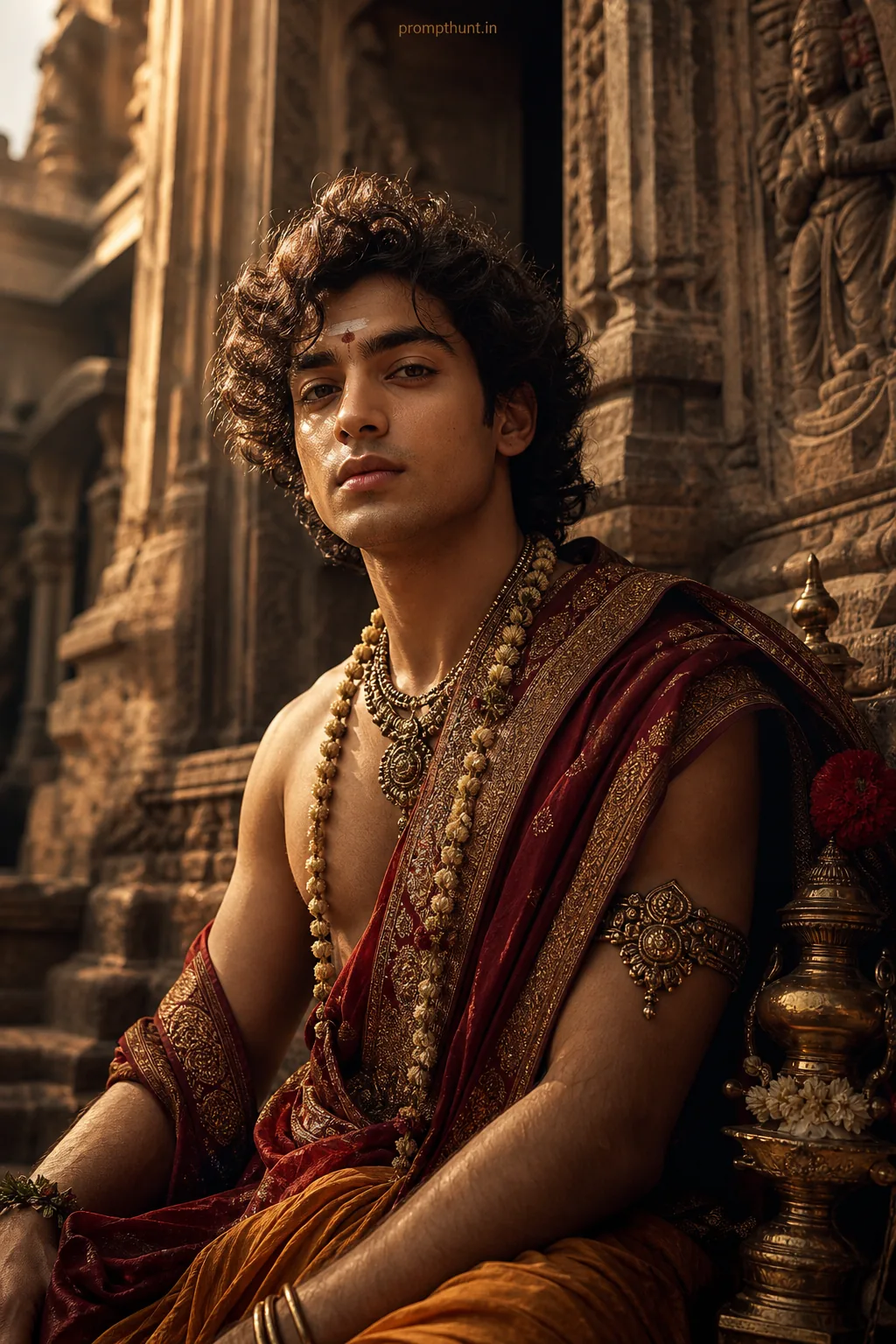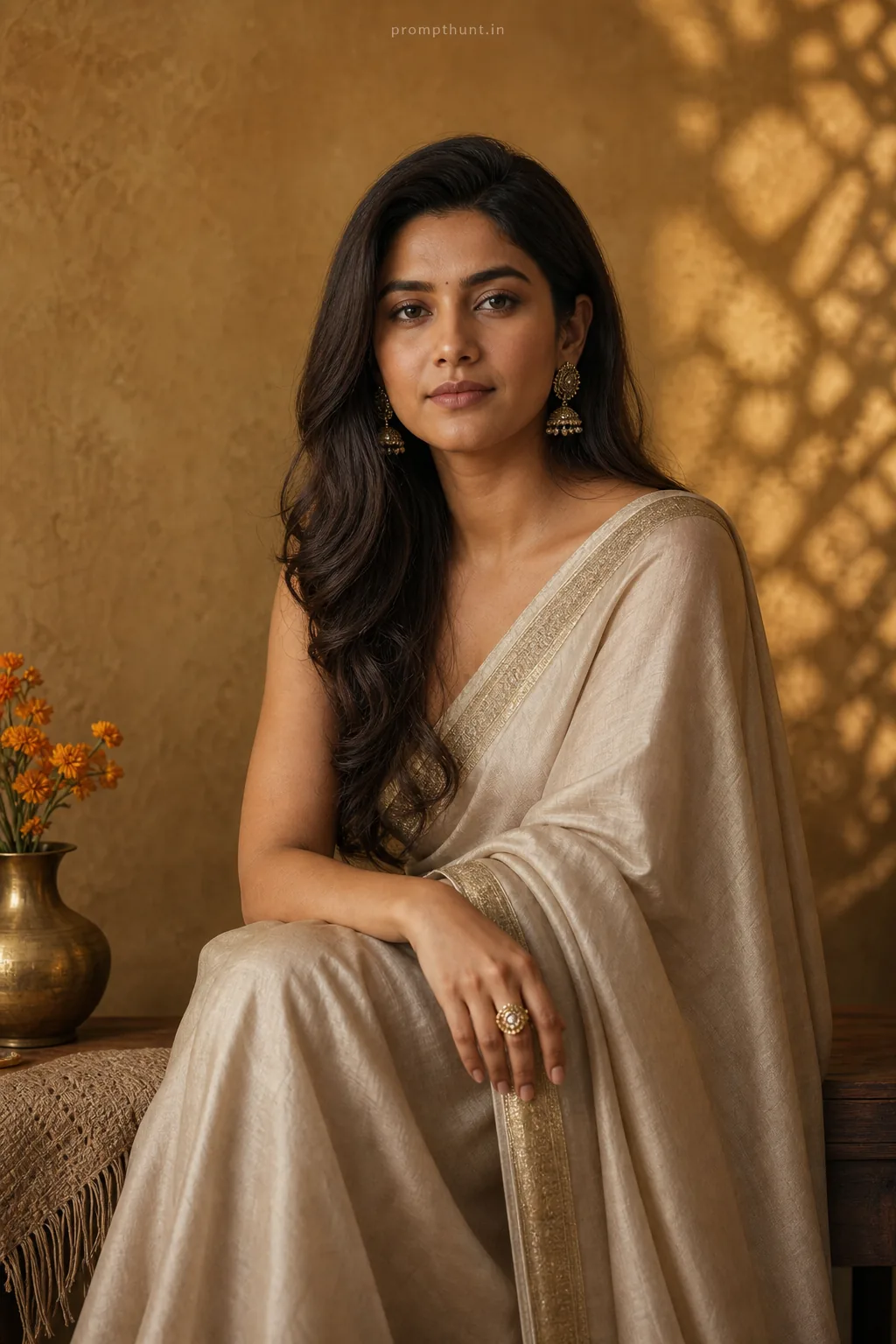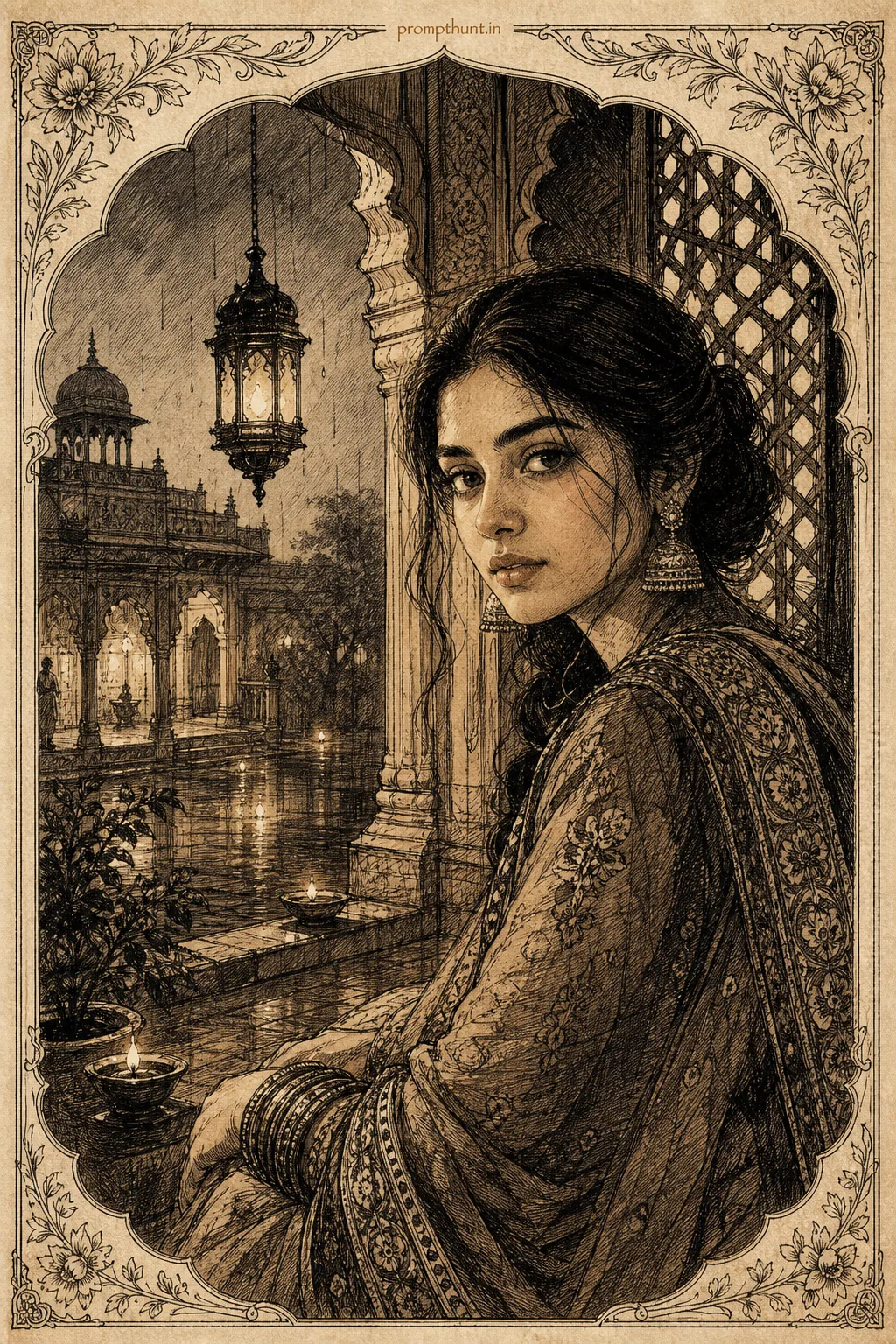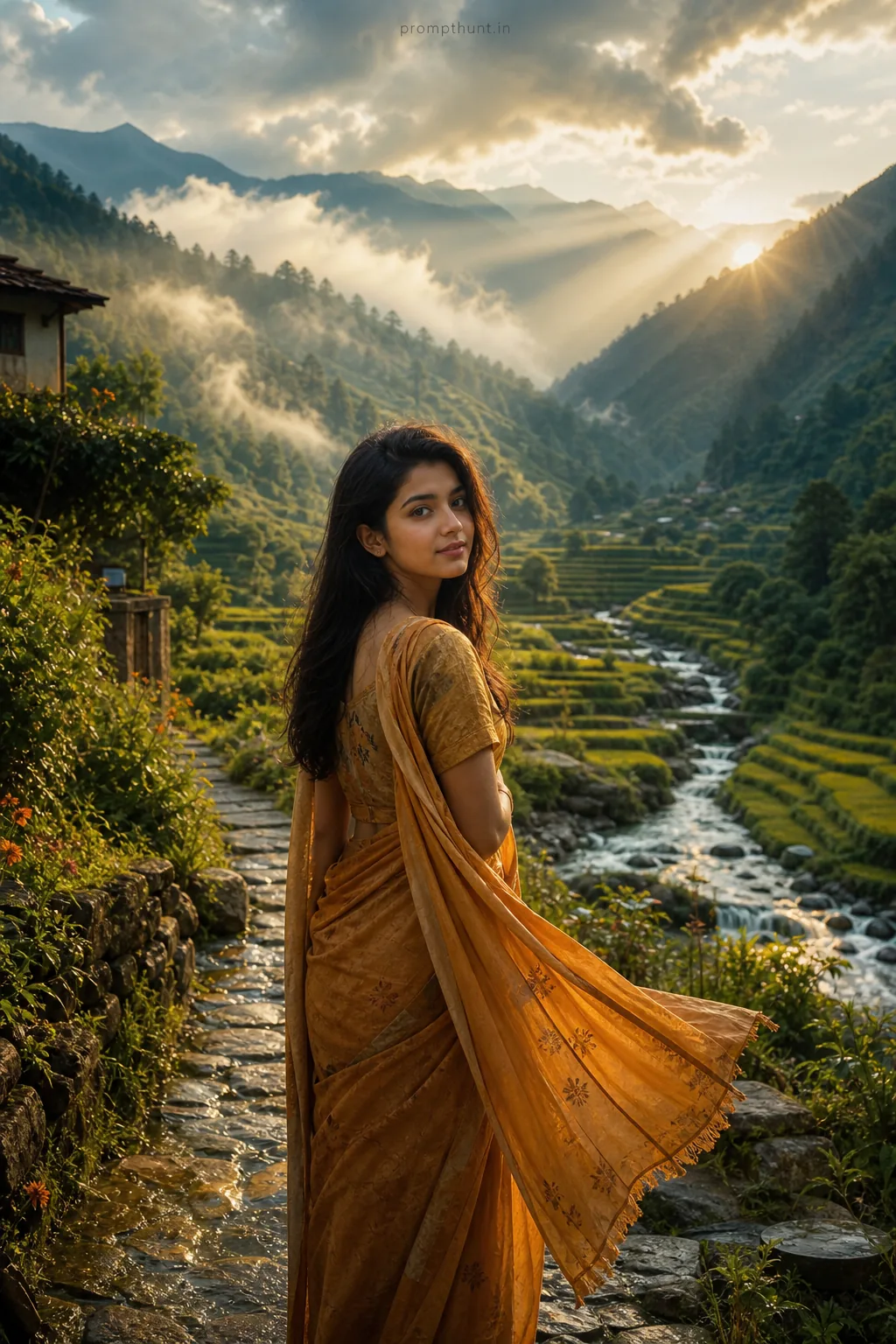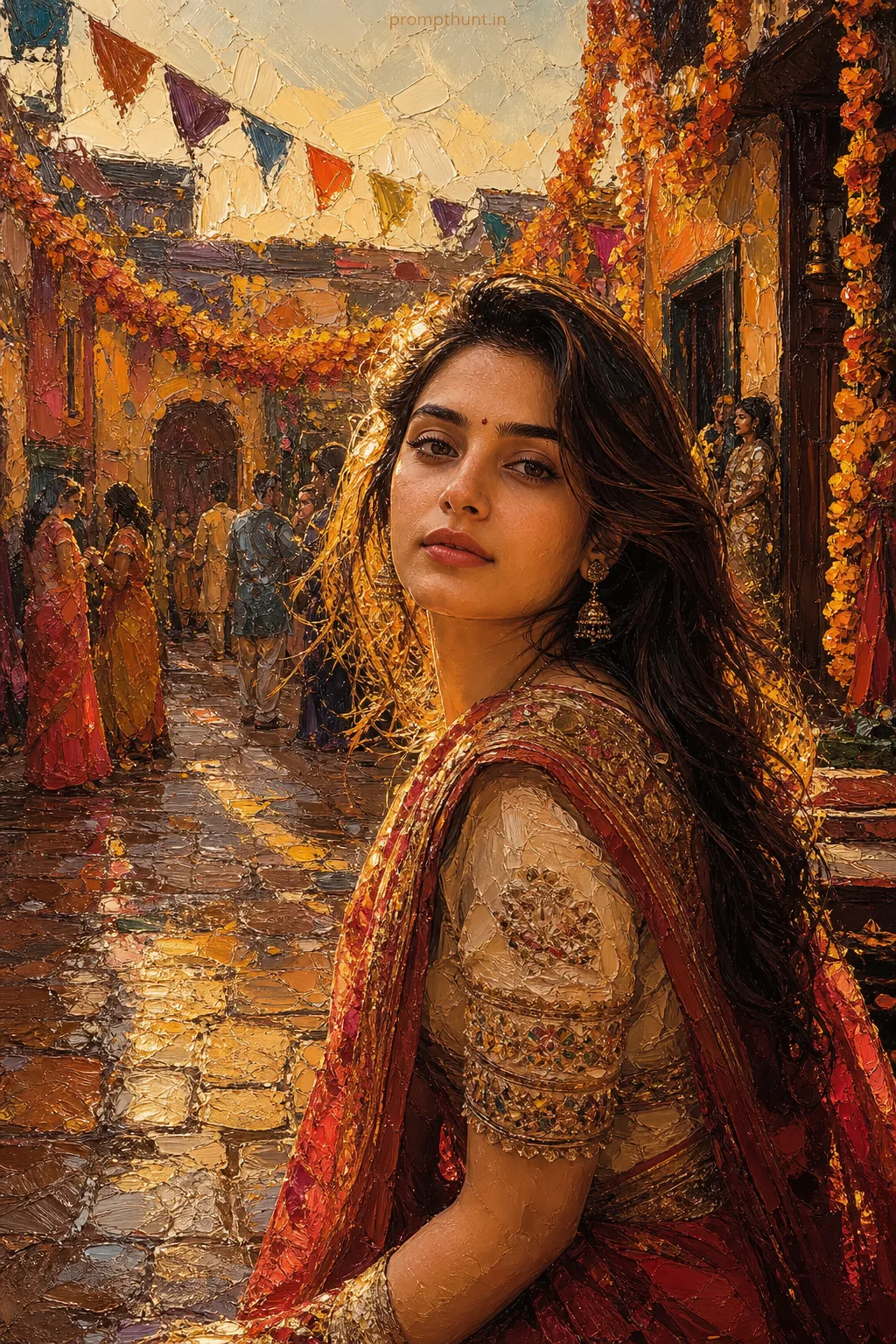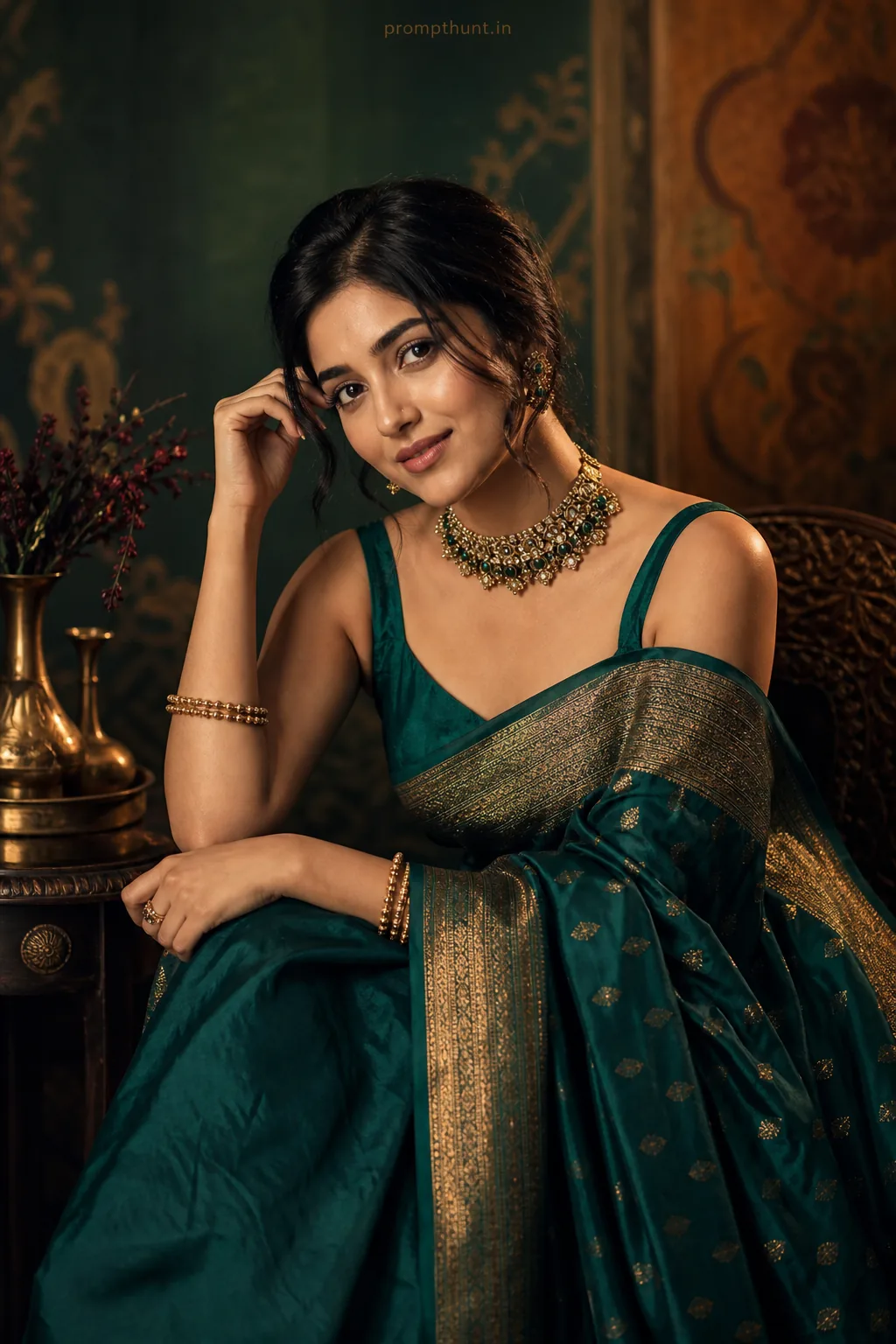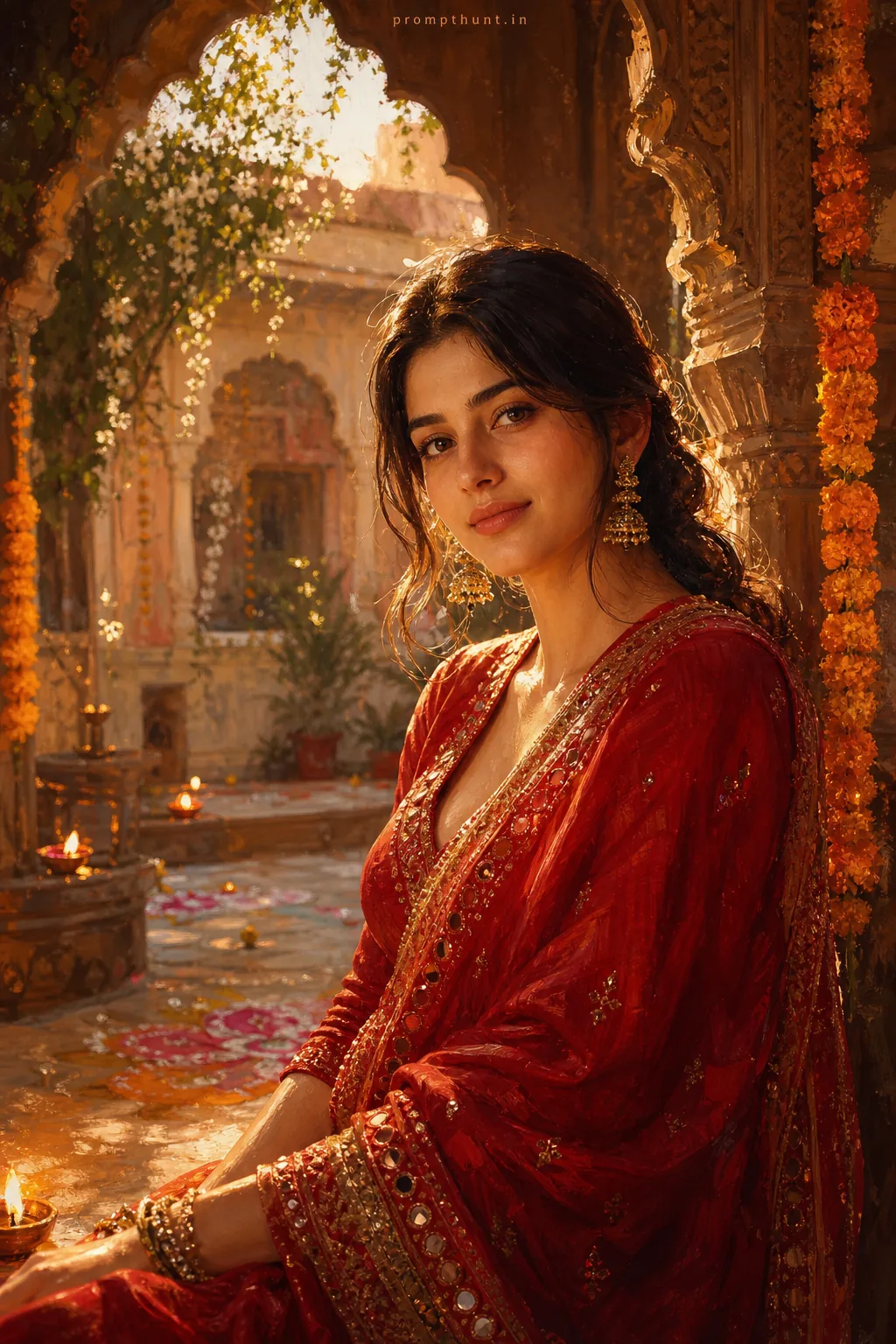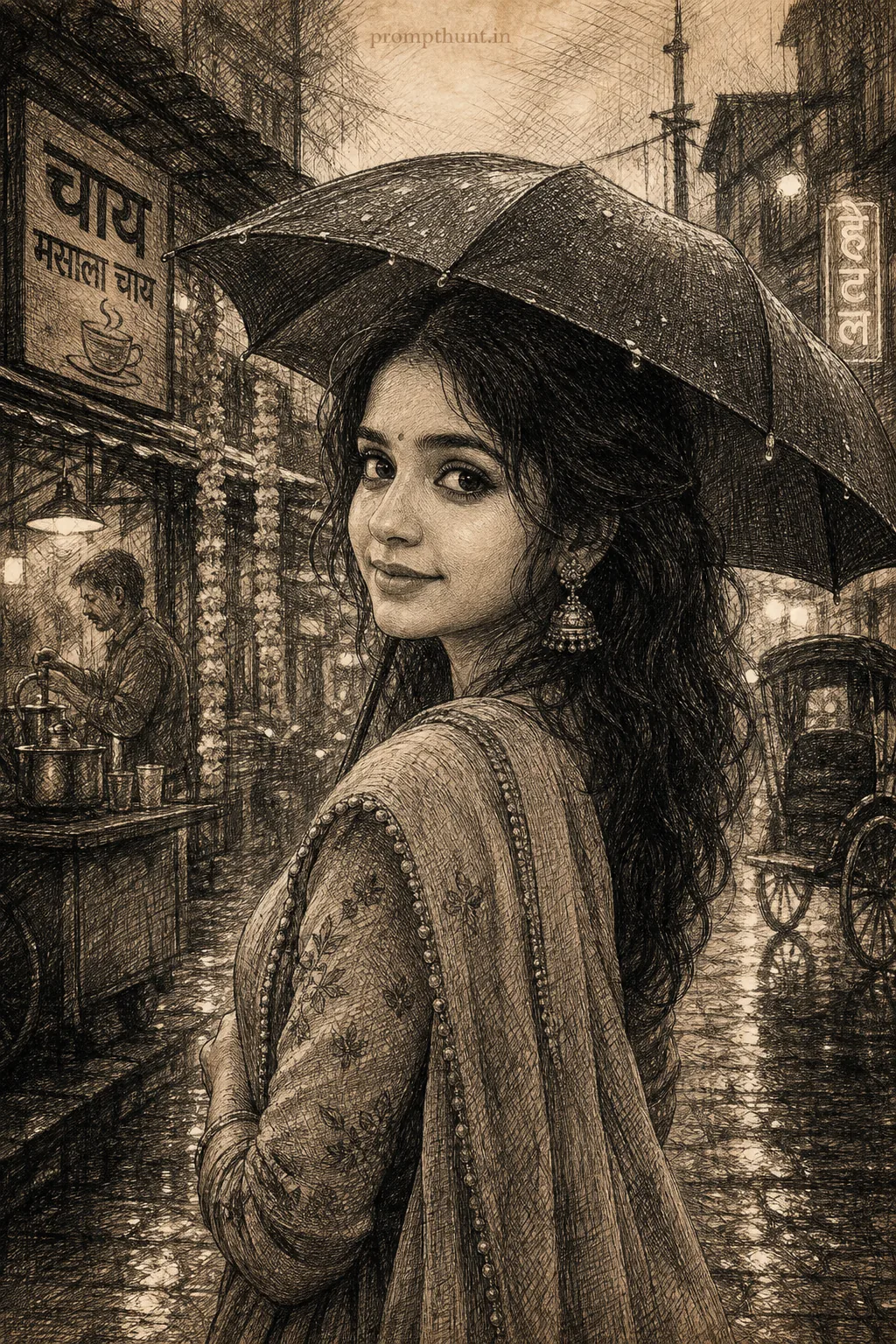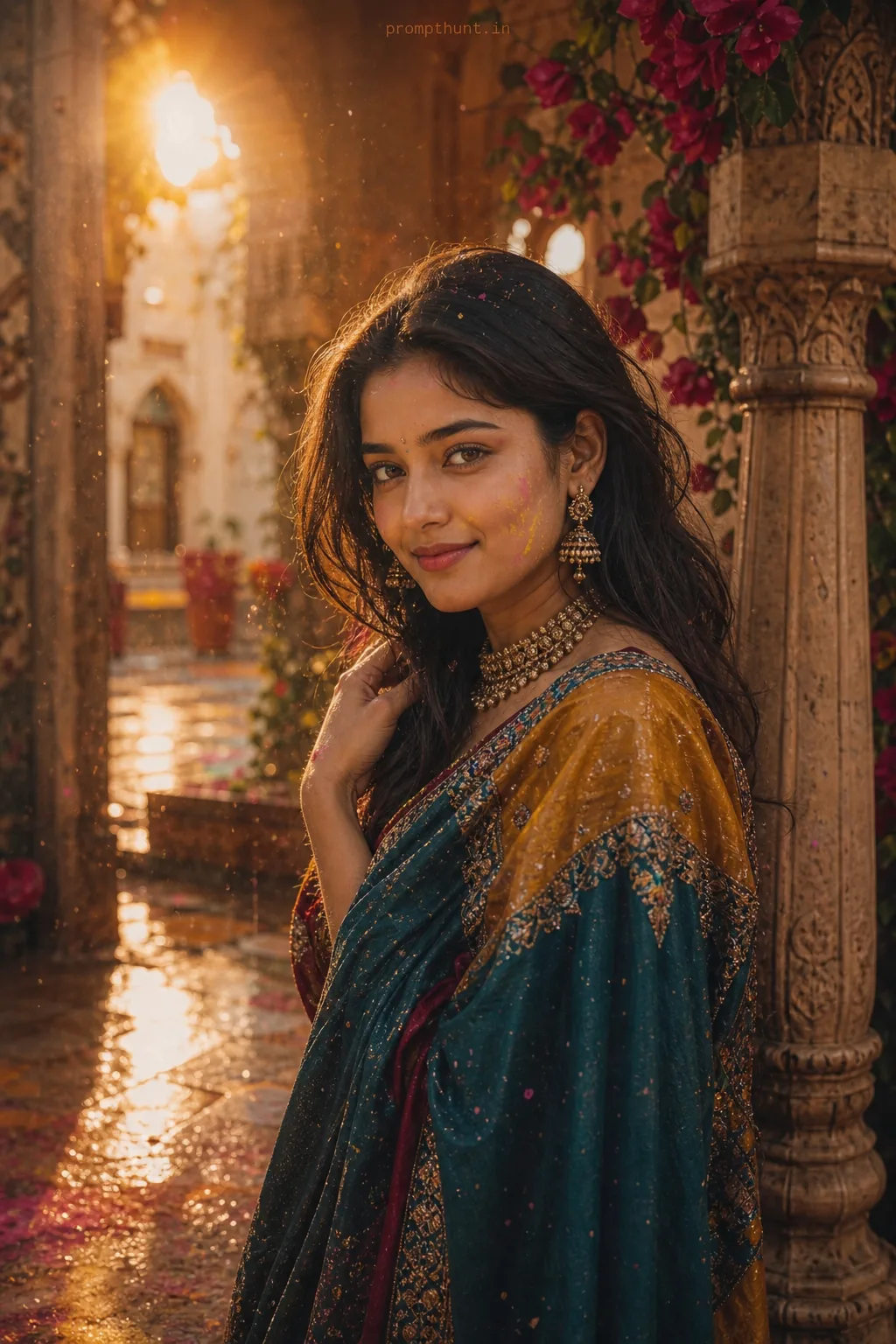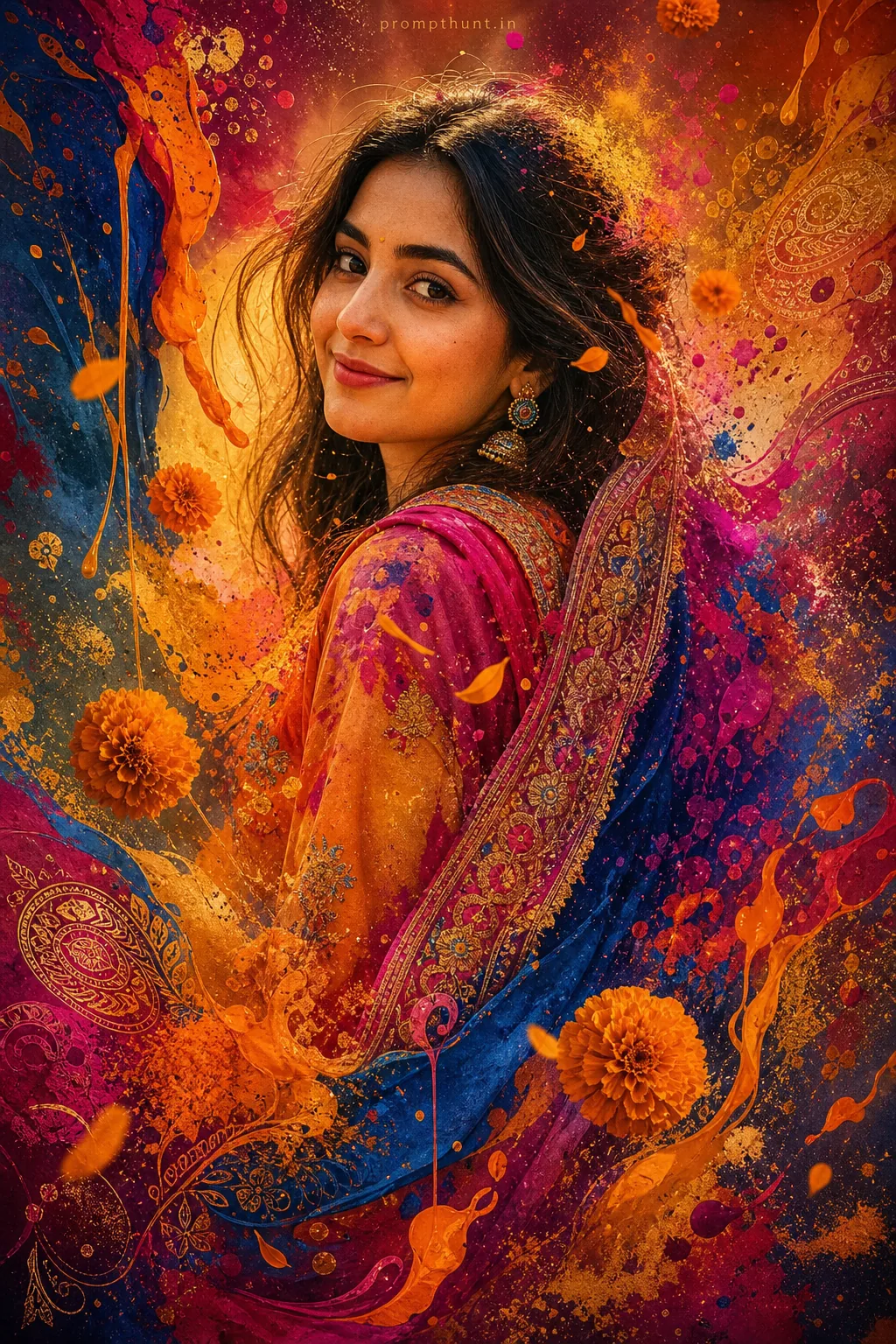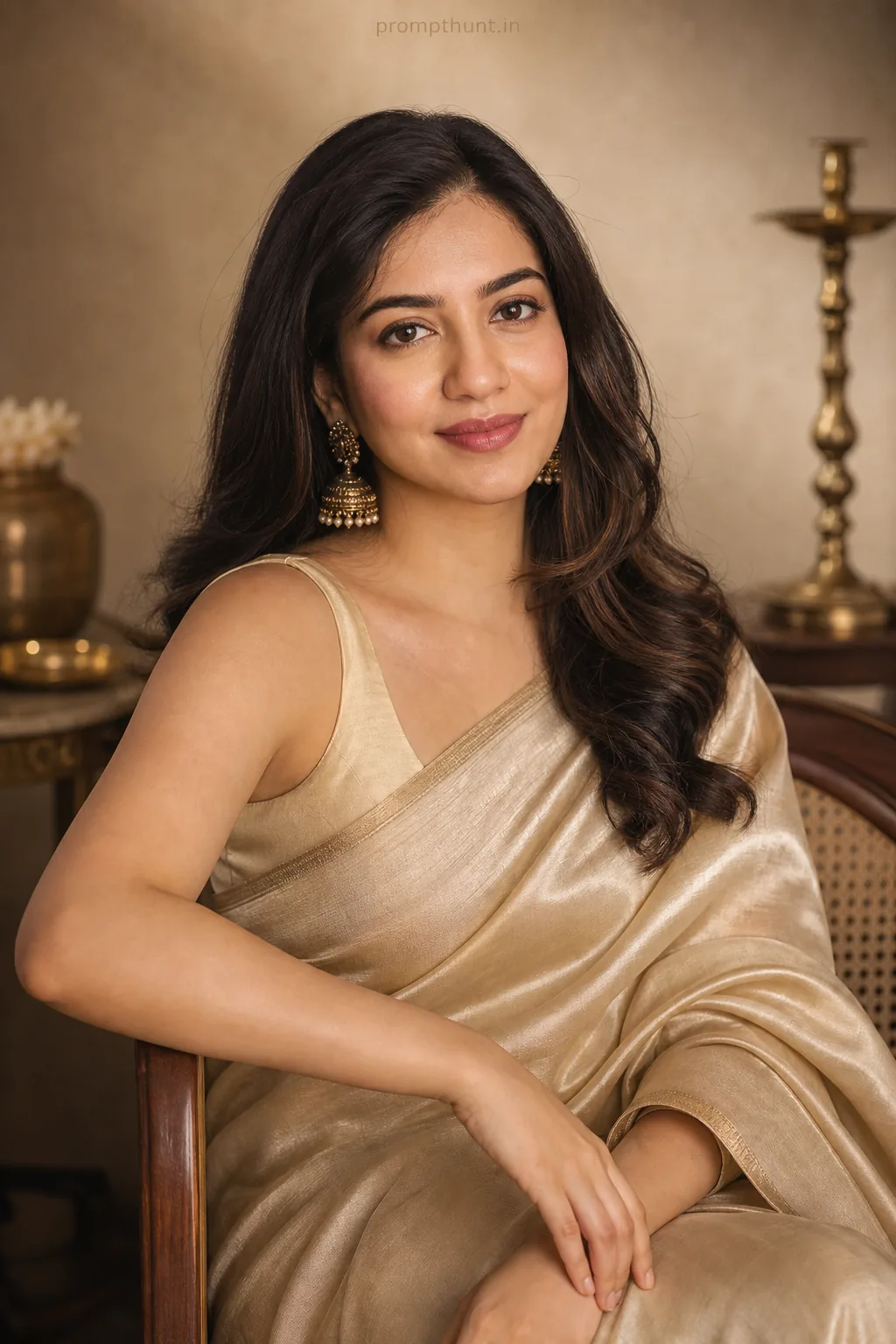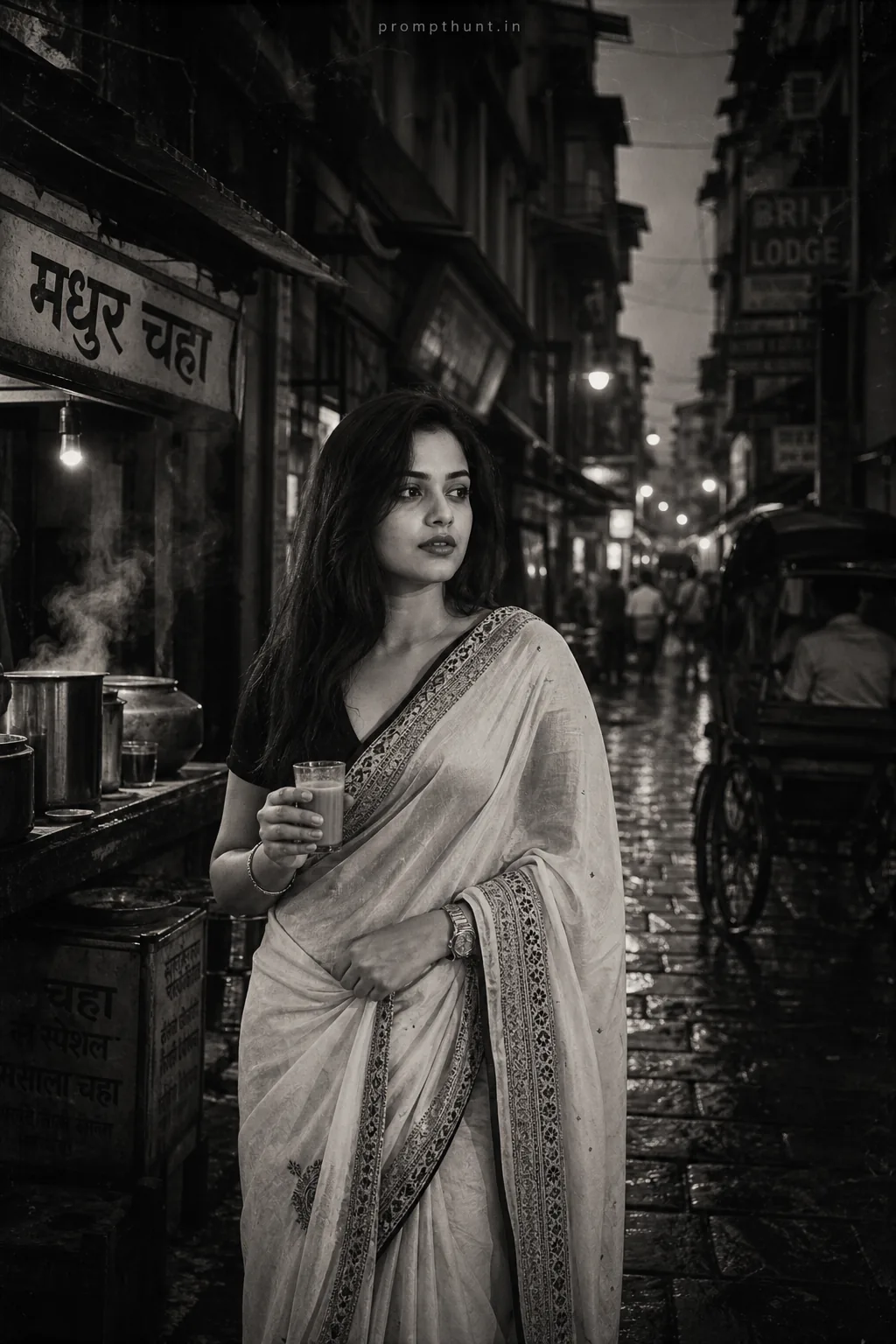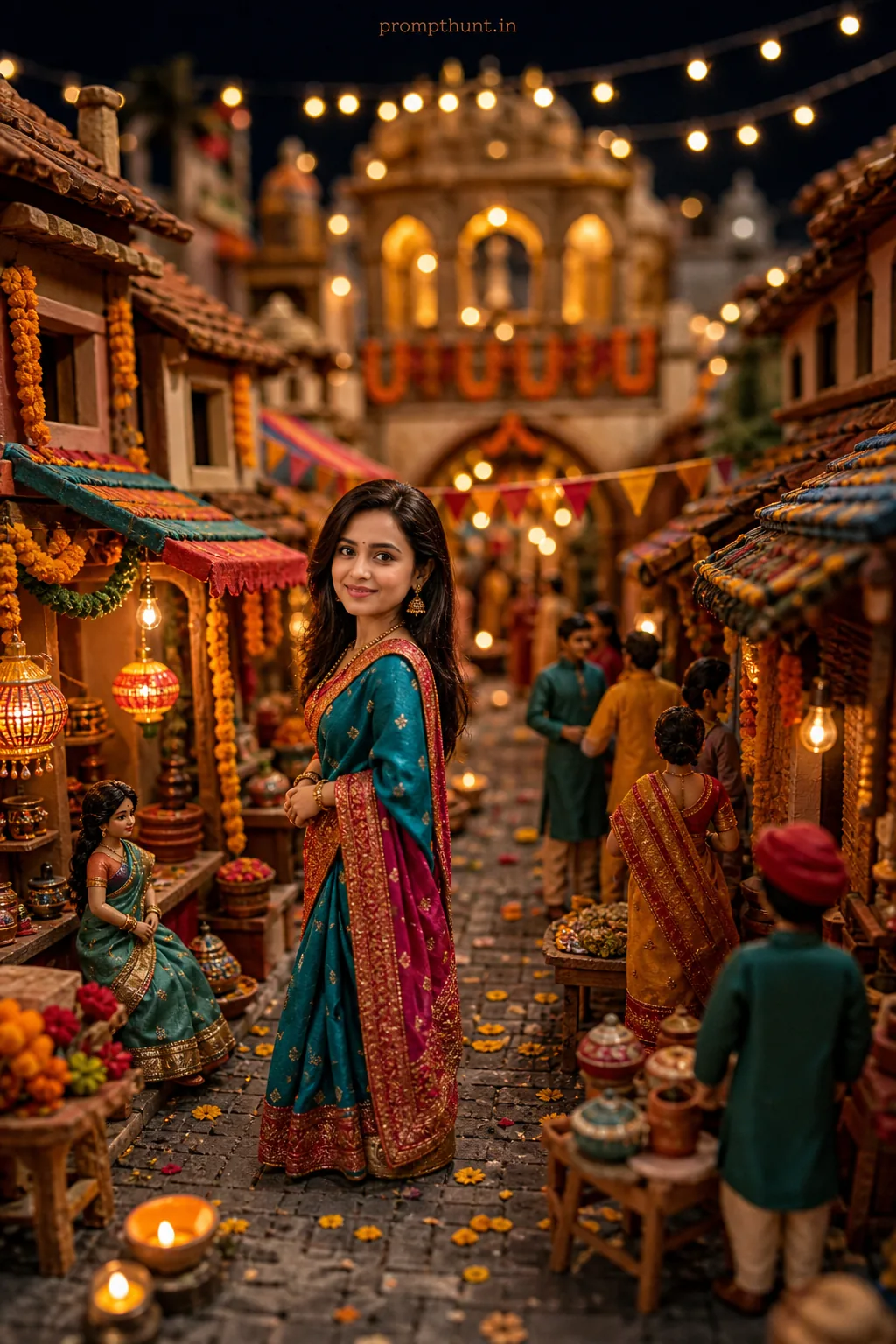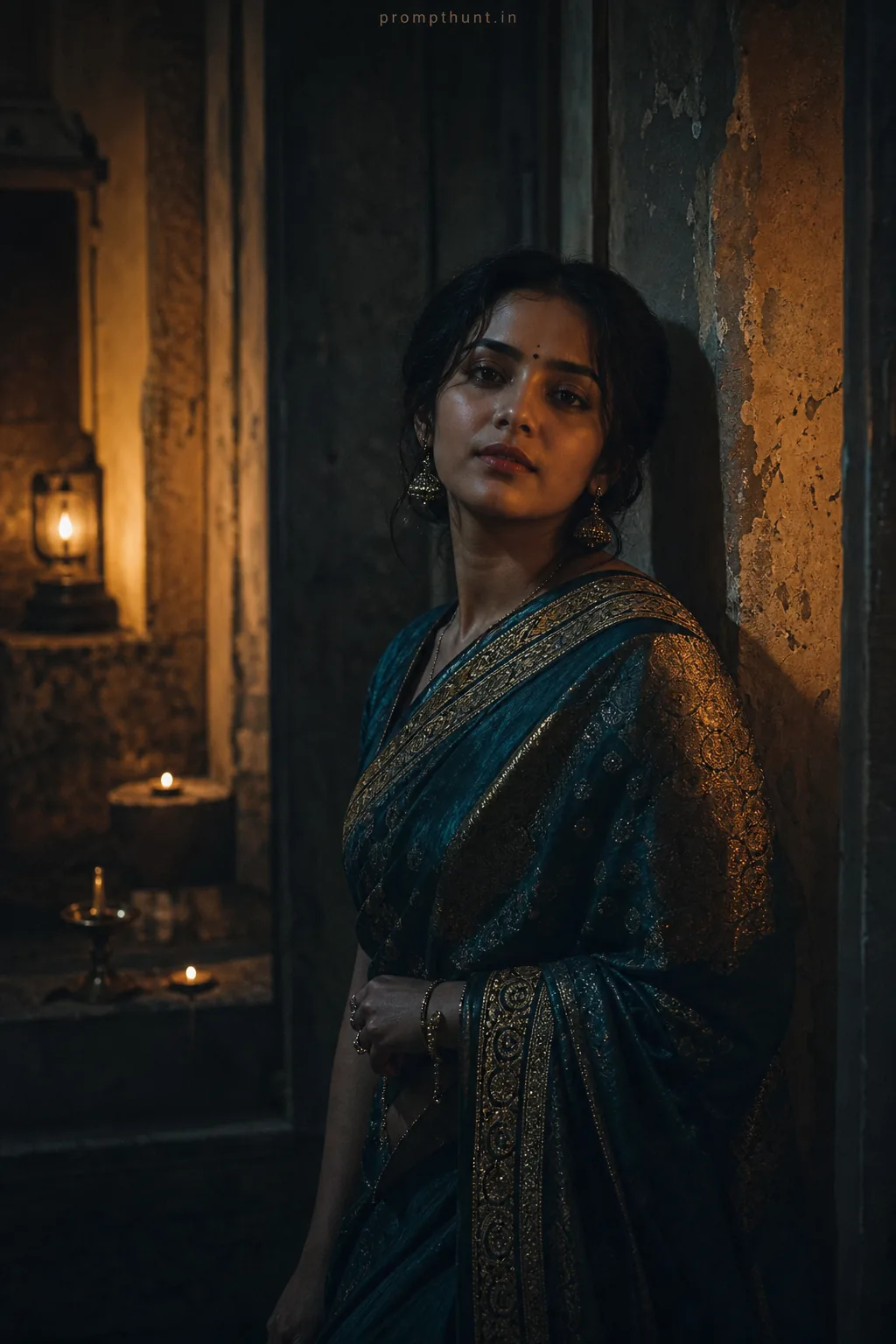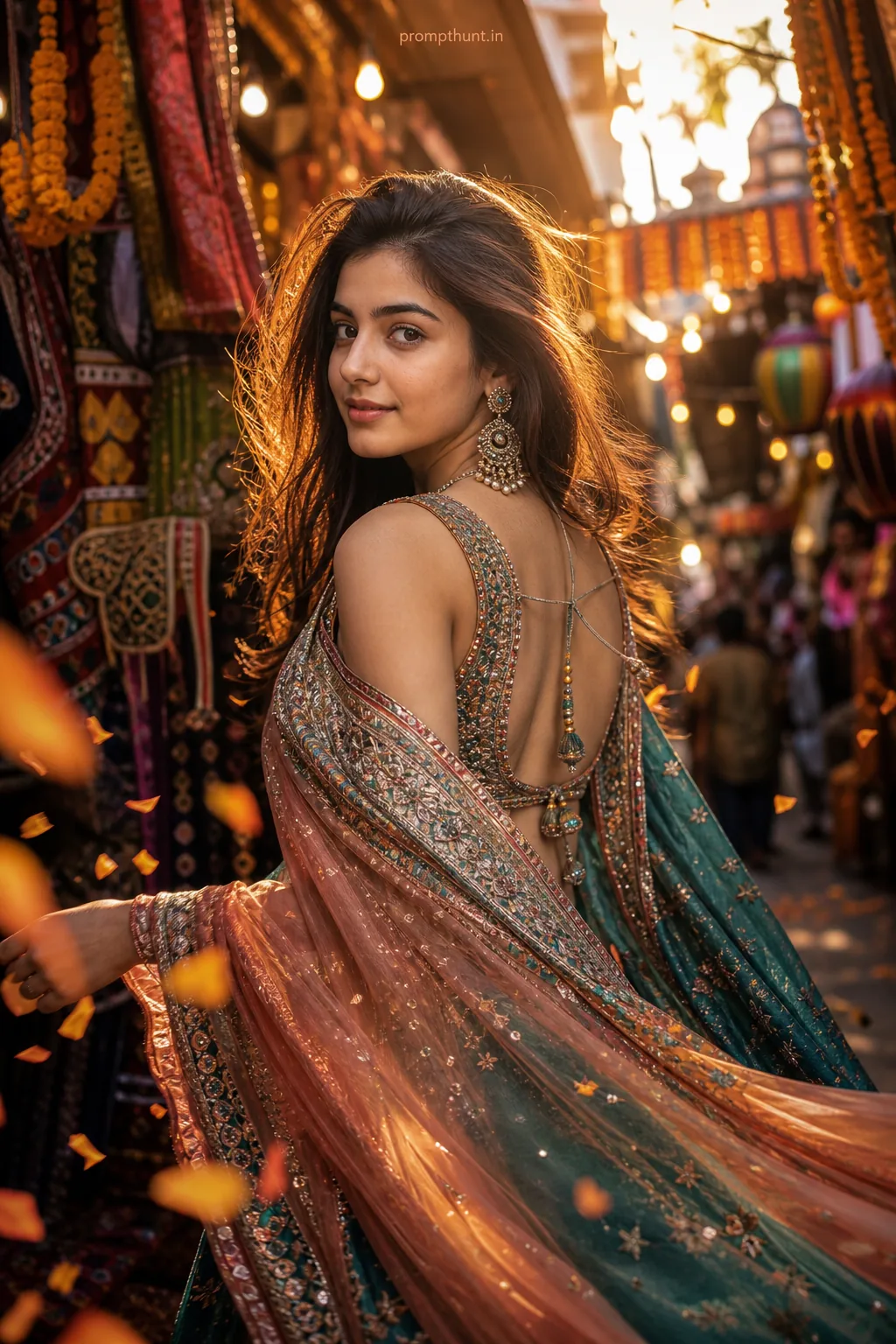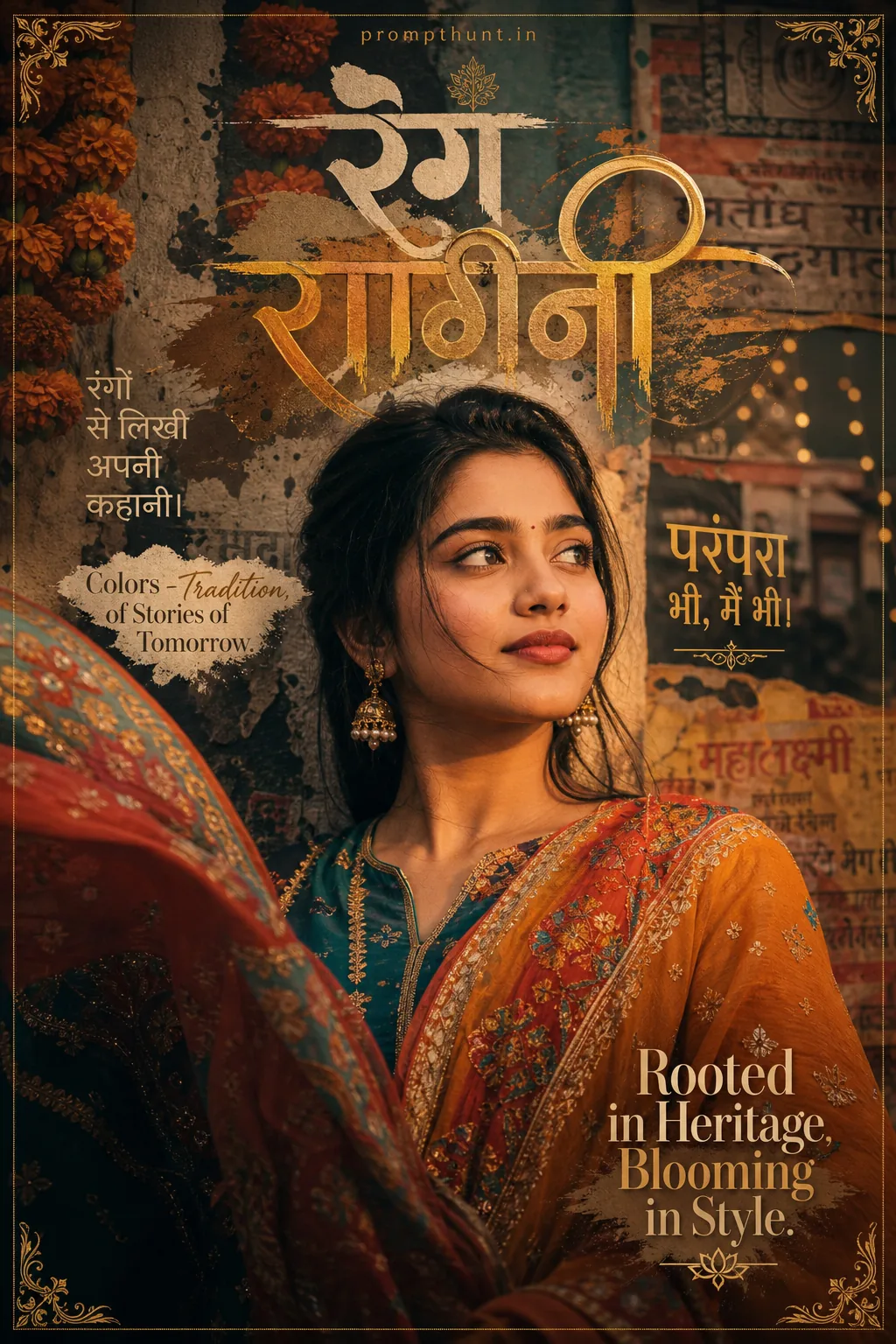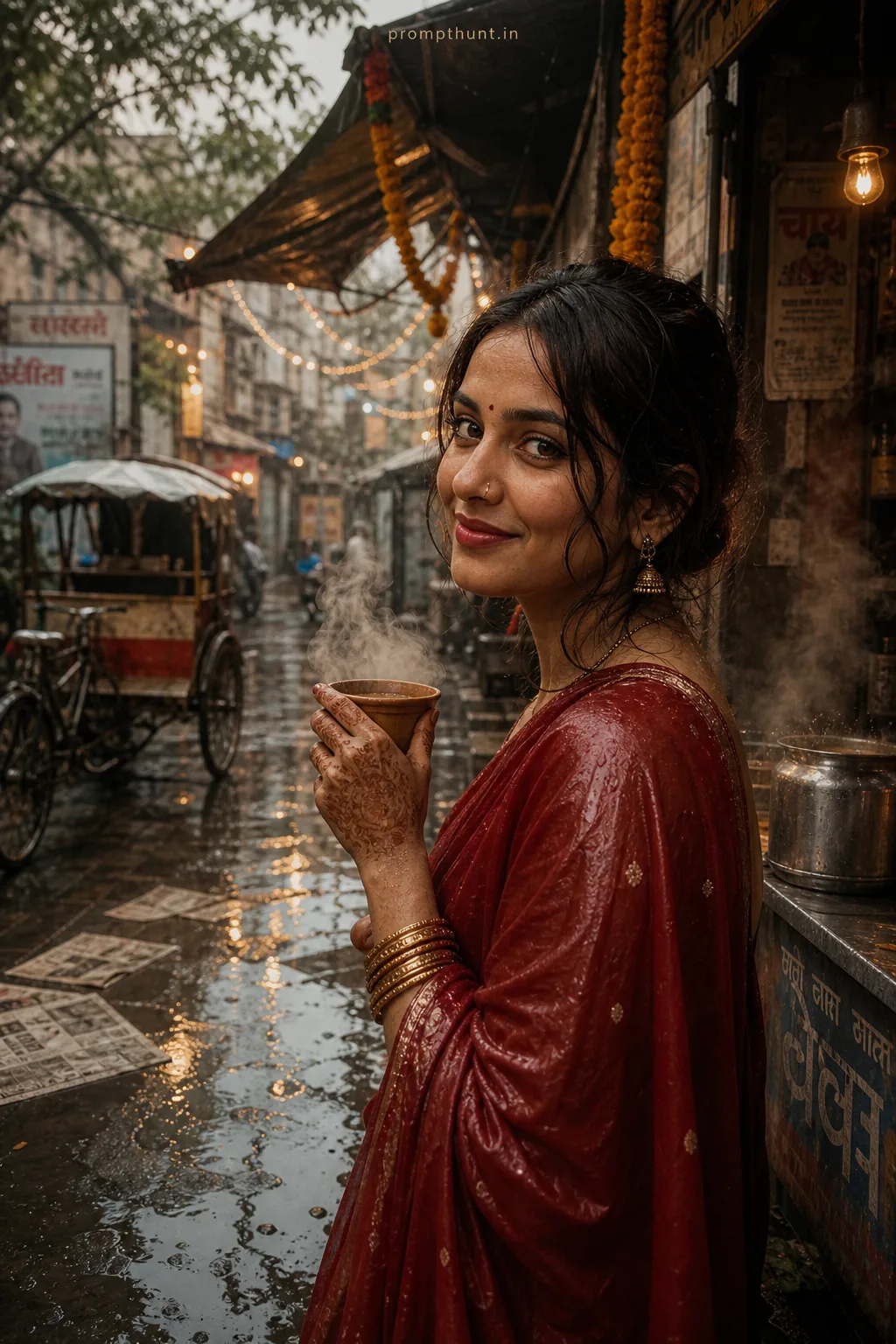
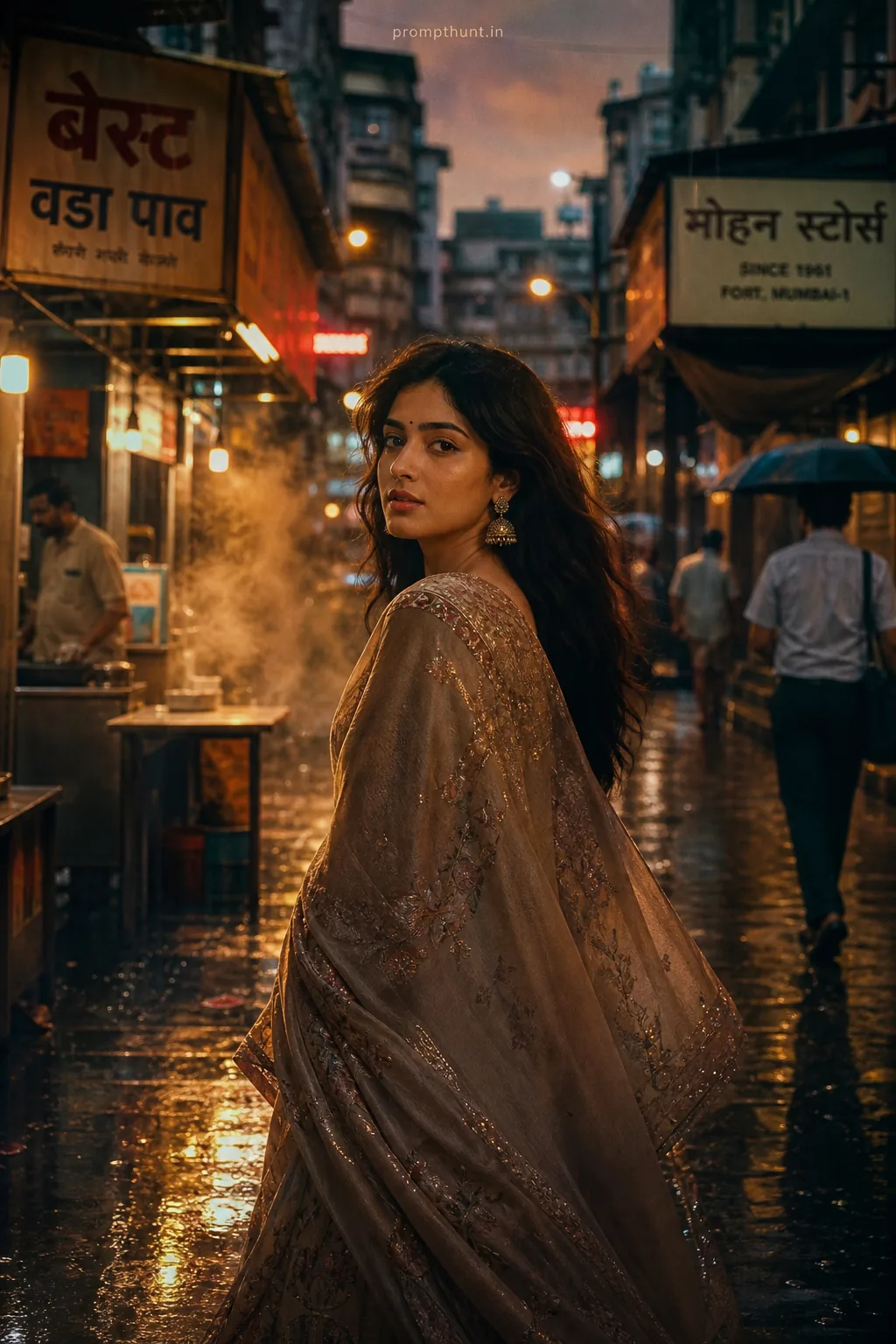
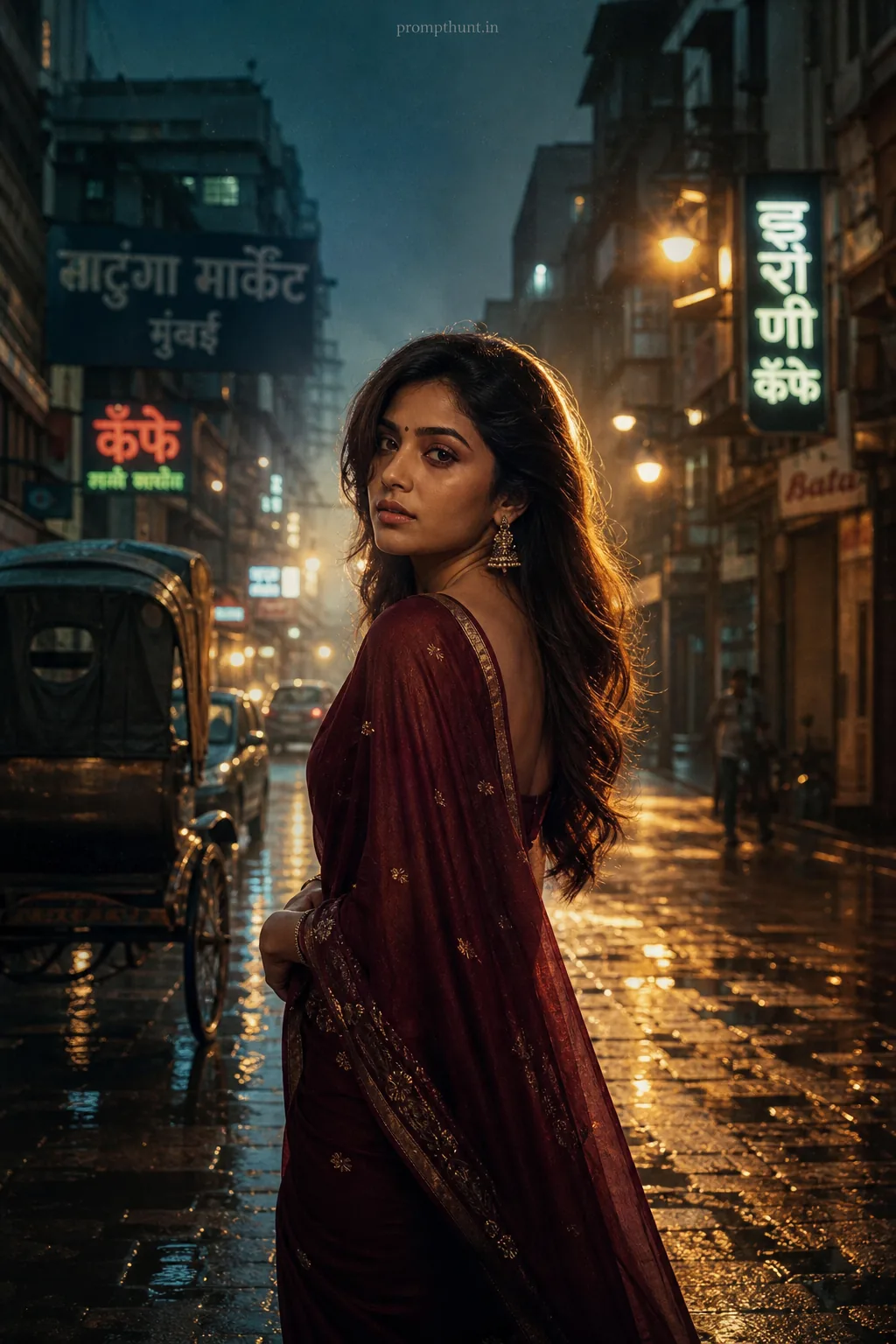
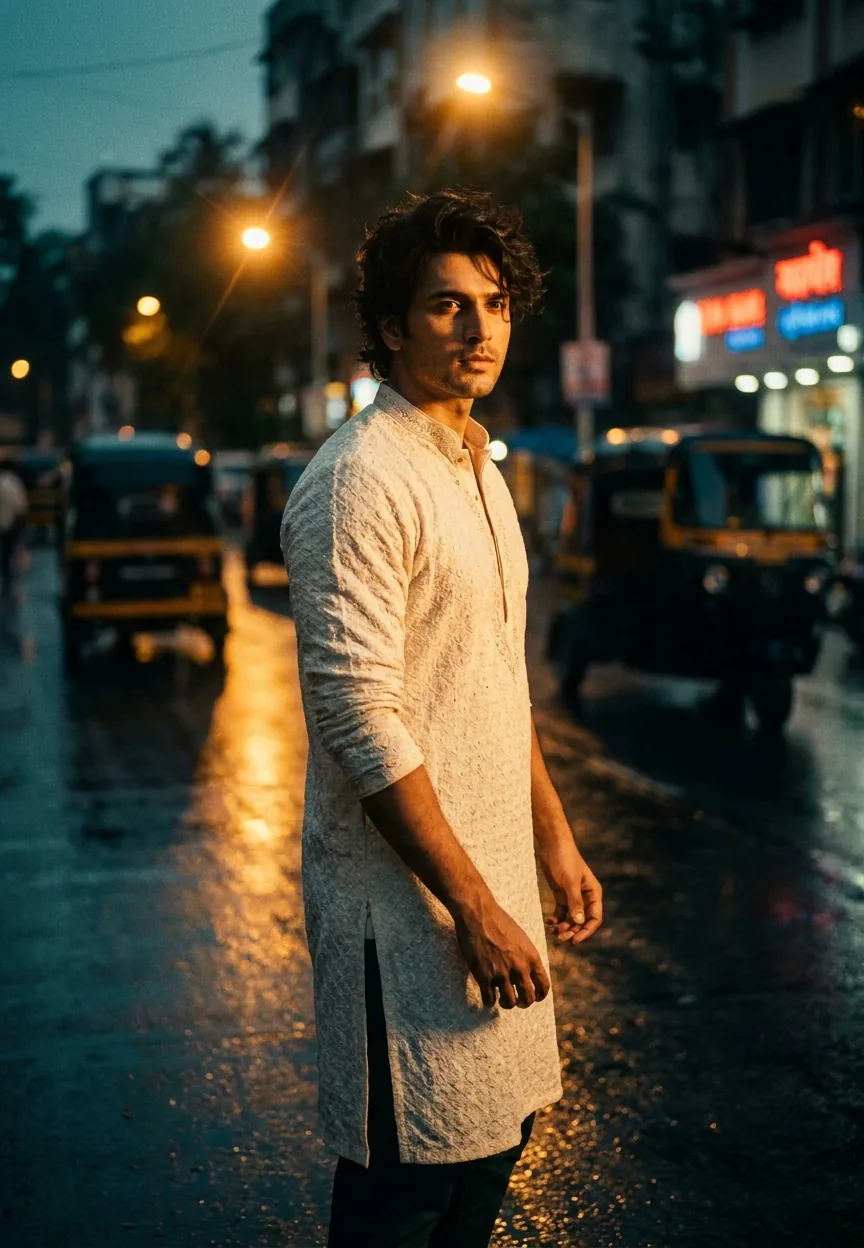
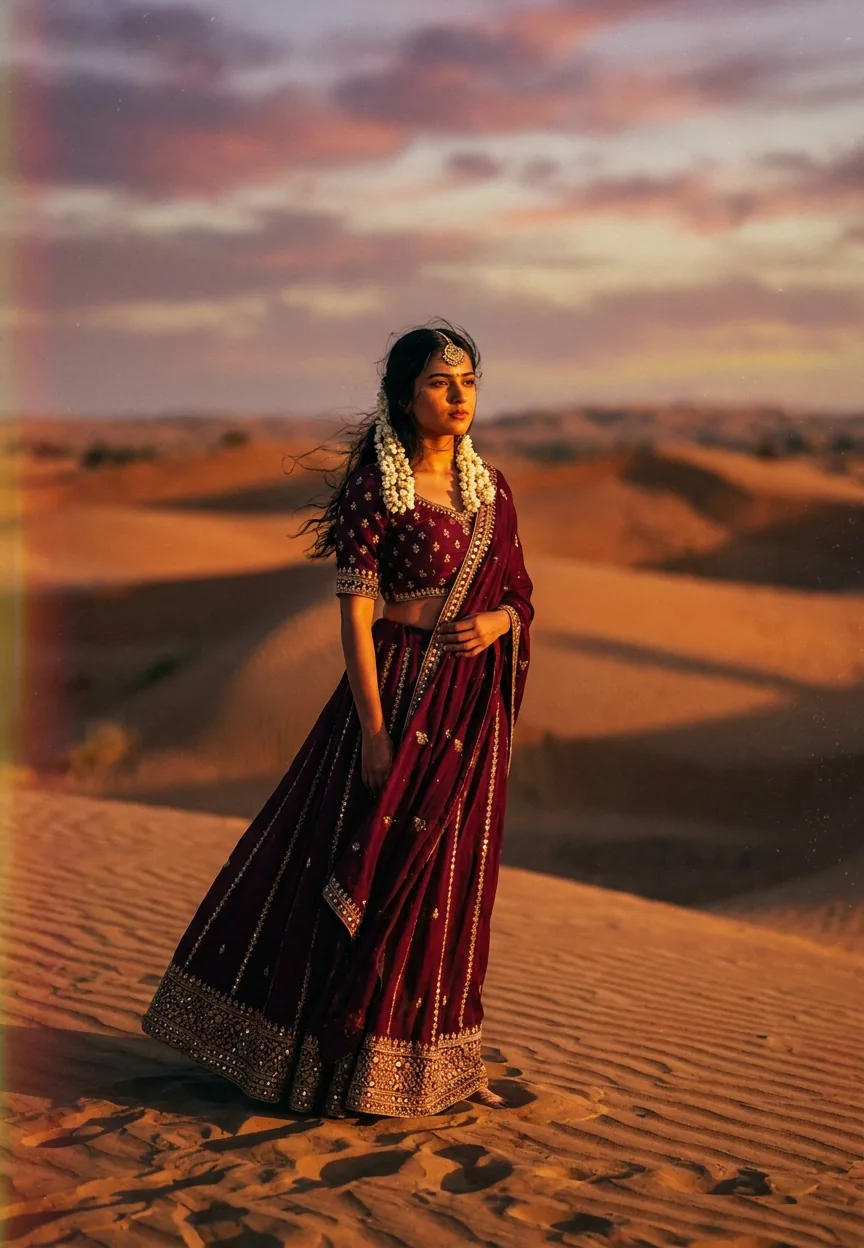
A Romantic Bollywood Monsoon cinematic photography prompt recreates the lush, rain-soaked drama of classic Hindi film visuals using AI. Specify a Mumbai street setting, golden hour lighting, Kodak Vision3 500T color grading, teal and orange tones, an Arri Alexa camera reference, and 85mm anamorphic lens for authentic Bollywood cinematic results every single time.
There is a reason Bollywood has been making audiences cry in the rain for seventy years. The monsoon scene is basically its own film genre. Two people. Wet cobblestones. A silk saree clinging dramatically to someone's better judgement. And now, thanks to AI image generators, you can recreate that whole cinematic photography magic without leaving your living room or ruining an actual silk saree. (The dry-cleaning bills alone would fund a short film.) This guide gives you the exact prompt, the step-by-step method, and the honest truth about when this style absolutely slaps — and when it goes sideways fast.
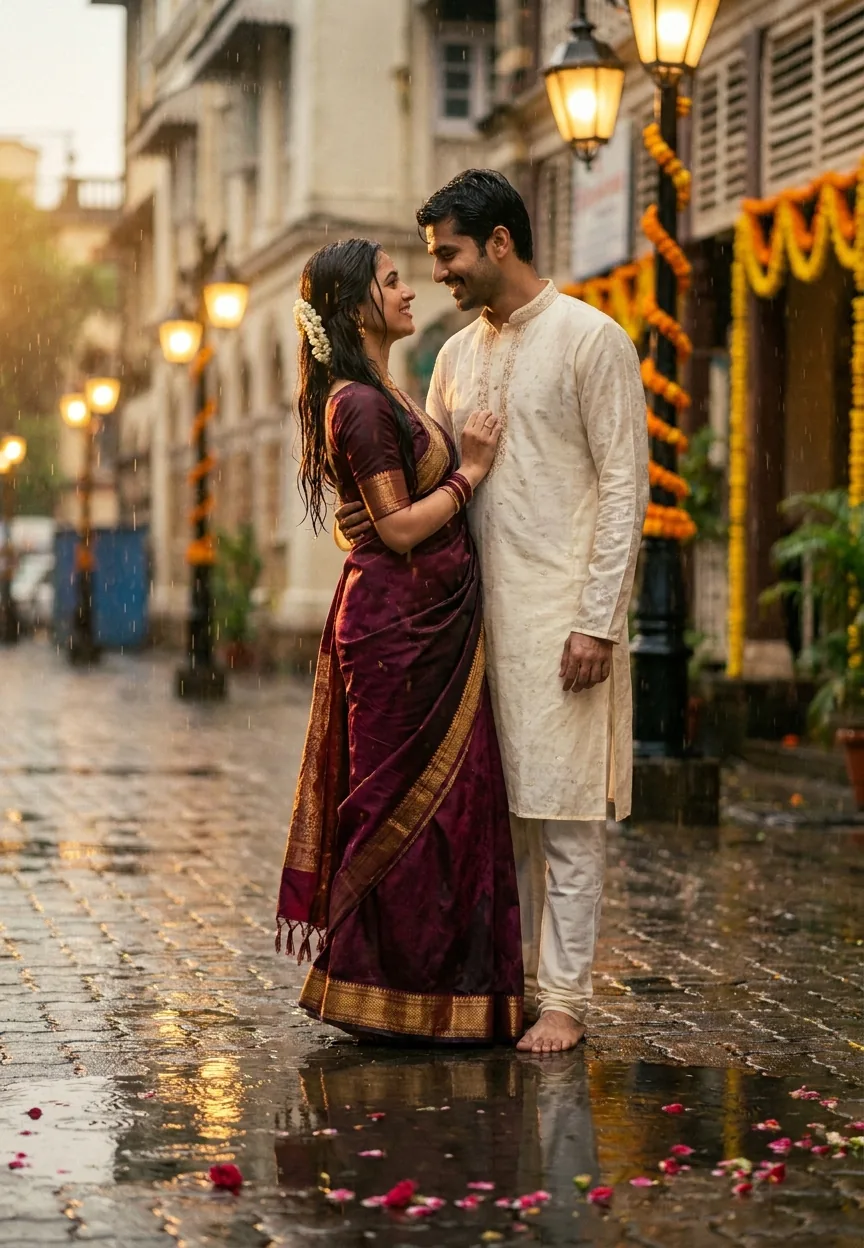
Use this Bollywood monsoon prompt with Midjourney or Leonardo AI, reference Kodak Vision3 500T grading and an Arri Alexa 85mm anamorphic lens, and you will get deeply cinematic, emotionally charged couple portraits that look pulled straight from a Sanjay Leela Bhansali production.
What Bollywood Cinematic Photography Actually Is
Cinematic photography is not just "photos that look like movies." That is like saying a biryani is just "flavoured rice." Technically accurate. Criminally incomplete.
Proper cinematic photography replicates the entire visual language of film — the colour grading, the lens characteristics, the lighting ratios, the shallow depth of field, and crucially, the emotional storytelling embedded in every frame. It is photography that makes you feel something before you have read a single caption.
The Bollywood variation adds a very specific cultural texture. Think warm Indian skin tones glowing under soft diffused light. Think jasmine flowers. Think the particular amber of a Mumbai street lantern at golden hour, doubled in a rain puddle. Think teal shadows and orange highlights in a ratio that would make a cinematographer weep with joy.
This style sits right at the intersection of editorial fashion photography, South Asian wedding imagery, and prestige Hindi cinema. It is an extremely specific neighbourhood, and it is gorgeous real estate.
The Cinematic Photography Prompt
Copy this exactly. Every word is doing a job.
A stunning cinematic photograph of a young Indian couple standing together on a rain-soaked Mumbai street at golden hour, the woman wearing a deep burgundy silk saree with intricate golden zari border, her wet hair partially pinned back with jasmine flowers, the man dressed in a crisp ivory kurta with subtle embroidery, both sharing an intimate gaze filled with warmth and longing, soft bokeh background of glowing street lanterns and blurred marigold garlands hanging from old colonial buildings, raindrops catching golden light creating a dreamy atmospheric haze, skin tones rich and warm with natural Indian complexion glowing under diffused cinematic lighting, shallow depth of field, film grain texture, Kodak Vision3 500T color grading with teal and orange tones, ultra-realistic 8K detail, shot on Arri Alexa camera with 85mm anamorphic lens, vertical 9:13 portrait composition, editorial magazine quality, deeply emotional and romantic storytelling mood, water puddles reflecting the couple silhouette below, rose petals scattered on wet cobblestone, authentic Bollywood cinematic aesthetic
How to Use This Prompt — Three Steps, No Surprises
Step one: pick your tool. Midjourney V6 or Leonardo AI's Phoenix model will handle this prompt best. Adobe Firefly is decent but struggles slightly with the anamorphic lens flare characteristics. Stable Diffusion with a cinematic checkpoint works too, though you will need to tweak the skin tone rendering manually.
Step two: paste the prompt in full. Do not abbreviate it. The detail density is the point. When you strip out "Kodak Vision3 500T" or "85mm anamorphic," you lose the specific film stock warmth and the characteristic oval bokeh that makes this style immediately recognisable. Every technical term is a stylistic instruction in disguise.
Step three: for Midjourney specifically, add --ar 9:13 --style raw --v 6 at the end. The --style raw flag stops Midjourney from over-processing the image into something that looks like a phone wallpaper from 2019. You want that slightly muted, film-authentic quality. Raw mode delivers it.
Run four variations. Pick the one where the bokeh lanterns sit naturally behind the subjects rather than appearing to grow out of someone's head. (It happens. AI is still figuring out spatial relationships. Fair enough.)
Tips for Best Results With This Style
Nine times out of ten, the prompt fails because the lighting instruction is too vague. "Golden hour" alone is not enough. The phrase "diffused cinematic lighting with warm amber fill and soft teal shadow separation" gives the model something to actually work with. Add it if your first results look flat.
Rule of thumb on skin tones: always specify "natural Indian complexion" and "warm rich skin tones" explicitly. AI models have a well-documented tendency to default toward lighter tones unless you are specific. This is not a minor aesthetic note — it is the difference between an authentic representation and something that completely misses the cultural brief.
The rain detail is load-bearing. If your result looks dry, add "heavy monsoon rain mid-frame, visible individual raindrops backlit by golden light" to the prompt. The atmospheric haze that makes this style so dreamy comes almost entirely from the rain catching and scattering light. No rain, no magic.
For the colour grade, Kodak Vision3 500T is a specific film stock with lifted shadows, warm midtones, and a slight green-teal shift in the darks. If your output looks too saturated or too clean, add "desaturated highlights, lifted black point, analogue film colour science" to pull it back toward the real thing.
One more: vertical 9:13 is not the same as 9:16. The slightly taller ratio gives you more room for environmental storytelling above the subjects — a fragment of colonial architecture, a string of marigold garlands, a rain-blurred streetlight. That architectural headroom is what separates editorial quality from a portrait that could have been taken at any wedding in any city.
Why This Style Is Trending Right Now
Indian wedding photography has been moving toward cinematic aesthetics for years. Pre-wedding shoots now regularly reference specific Bollywood directors — you will genuinely see briefs that say "we want Bhansali colour palette, Imtiaz Ali intimacy." That is a real brief that real photographers receive.
AI has made that cinematic quality accessible to couples who cannot afford a 3-day pre-wedding shoot in Udaipur. A single well-crafted prompt generates images that genuinely look like production stills. For social media, for invitations, for creating a visual identity around a wedding — this is a practical creative tool now, not a novelty.
The monsoon aesthetic specifically is having a moment because it photographs beautifully in the AI medium. Rain adds depth layers — foreground droplets, midground subjects, background bokeh lights — that give the model's depth-of-field simulation real work to do. It is one of the few scenarios where AI cinematic photography actually competes seriously with real photography rather than just approximating it.
Honest Opinion — When This Prompt Works and When It Really Does Not
This prompt is genuinely one of the strongest AI cinematic photography setups I have seen for South Asian aesthetics. The technical specificity — the film stock, the lens, the camera body — gives modern models enough anchoring detail to produce consistently high-quality output. When it works, it properly works. You get images that feel like they belong in Filmfare or Vogue India.
But here is the honest version.
AI still struggles with hands. A romantic couple prompt almost always involves hands — holding, touching, reaching — and this is where the generation frequently falls apart. Expect to run the prompt eight to twelve times before you get a result where both people have the correct number of fingers arranged in a way that does not suggest they have recently had an accident. That is not a dig at the prompt. That is just the current state of the technology.
The anamorphic lens instruction produces beautiful oval bokeh in perhaps one in three generations. The other two will give you standard circular bokeh, which is fine but misses the specific widescreen cinematic quality that makes this style distinctive. If oval bokeh matters to you — and for the Bollywood aesthetic it genuinely does — be prepared to iterate.
Also: this style is not appropriate for every creative brief. The heightened emotion, the lush detail, the full-saturation romantic drama — it is magnificent for wedding content, editorial work, and emotional storytelling. It is completely wrong for minimalist brands, documentary contexts, or anything that needs to feel grounded and everyday. This is a very particular flavour. Delicious when you want it. Overwhelming when you do not.
Use it deliberately. Have a reason for the rain.
The Whole Thing in About Ninety Words
This Bollywood monsoon cinematic photography prompt is the real deal — specific enough to generate consistently beautiful results, culturally detailed enough to feel authentic, and technically grounded enough that AI models actually know what to do with it. Paste it in full. Do not edit out the film stock references. Iterate on the hands (always the hands). And if someone asks why you spent forty-five