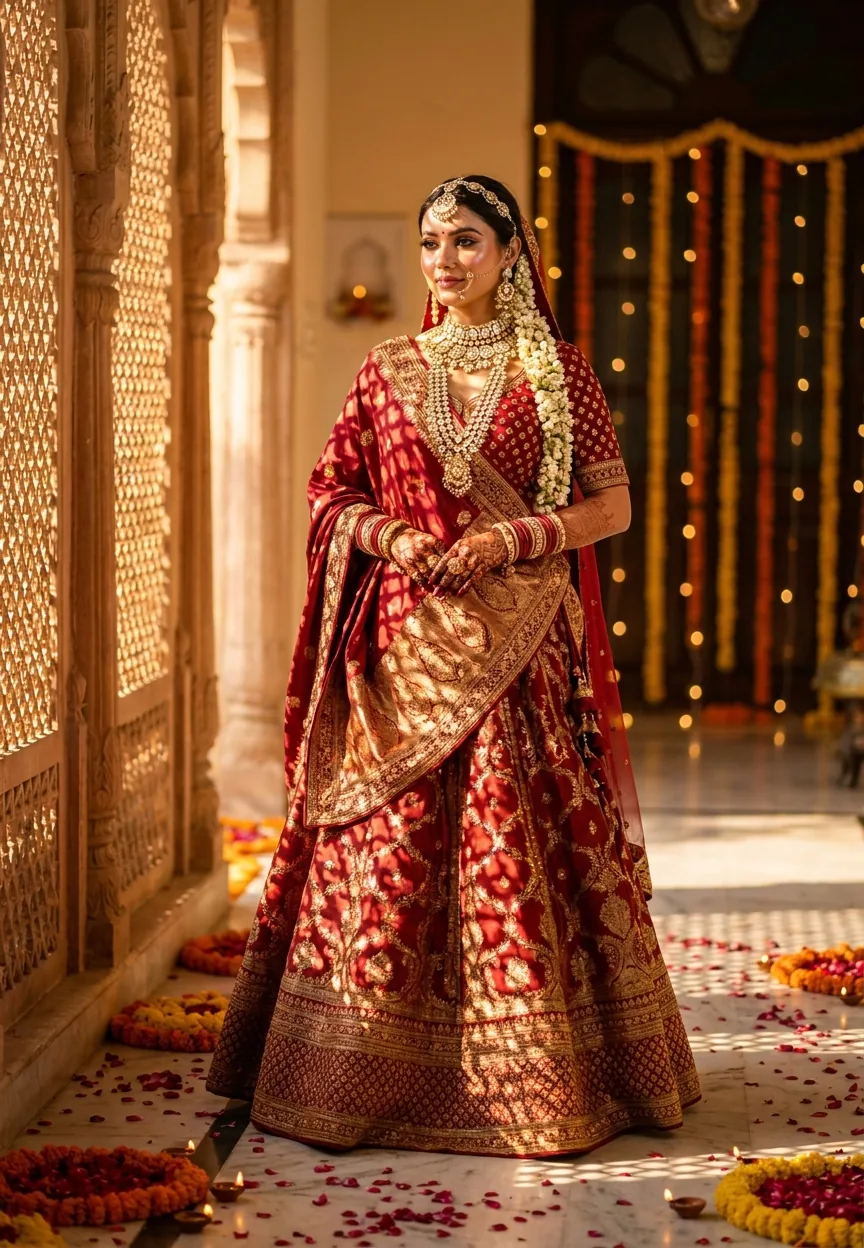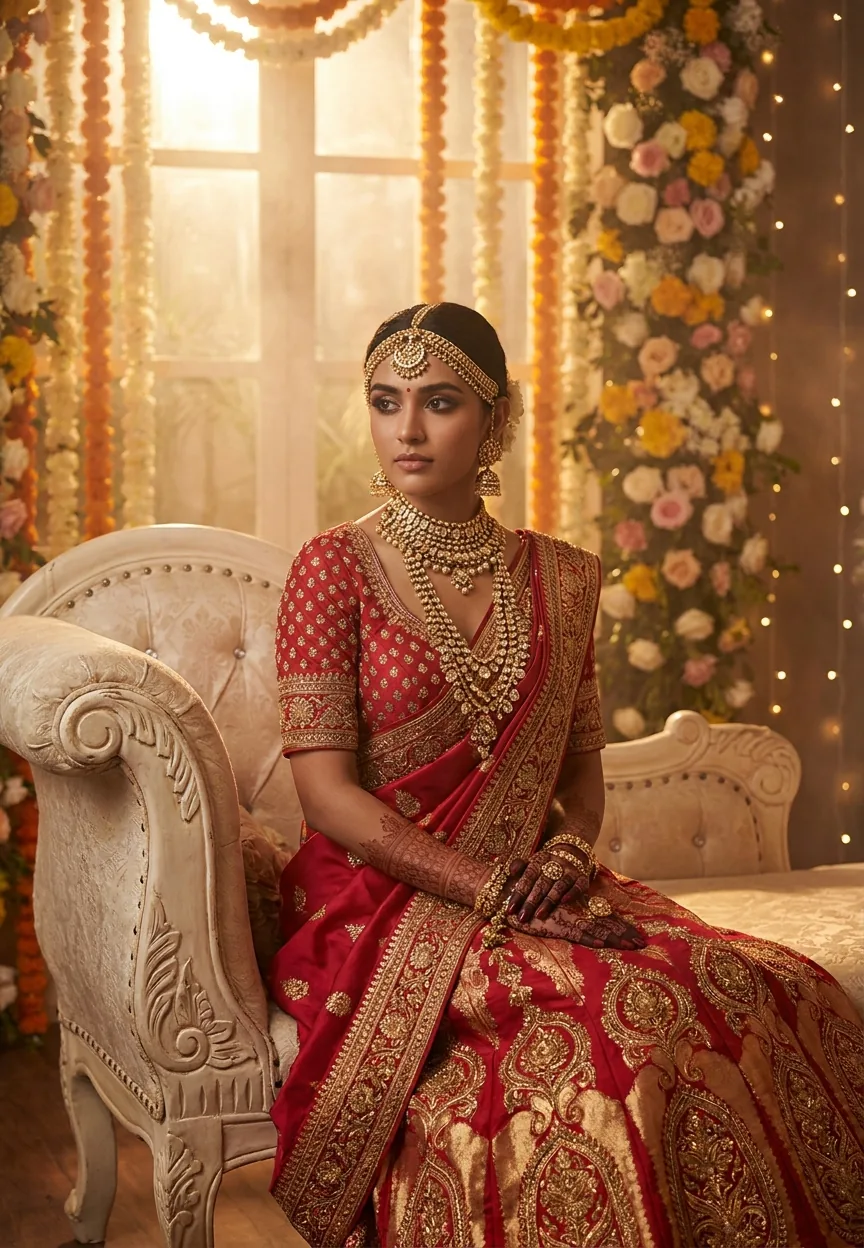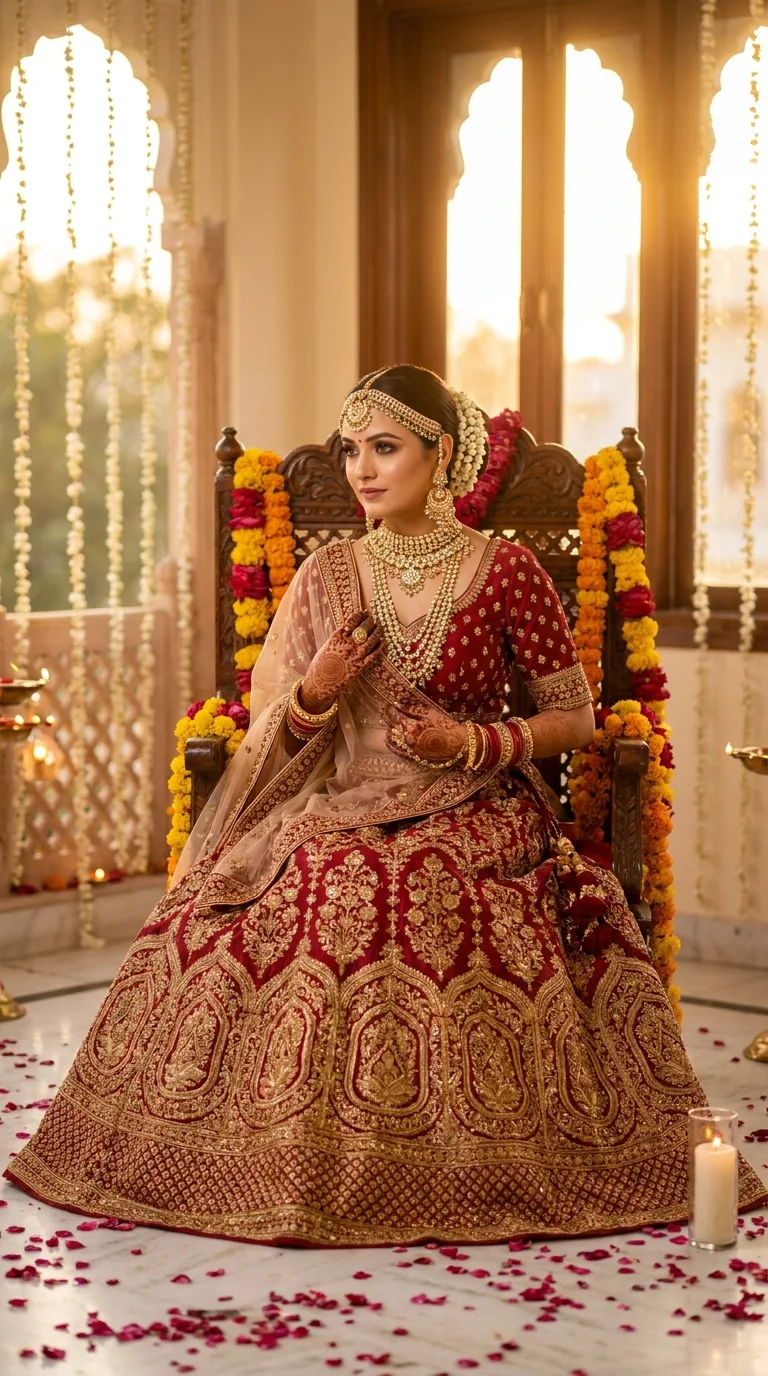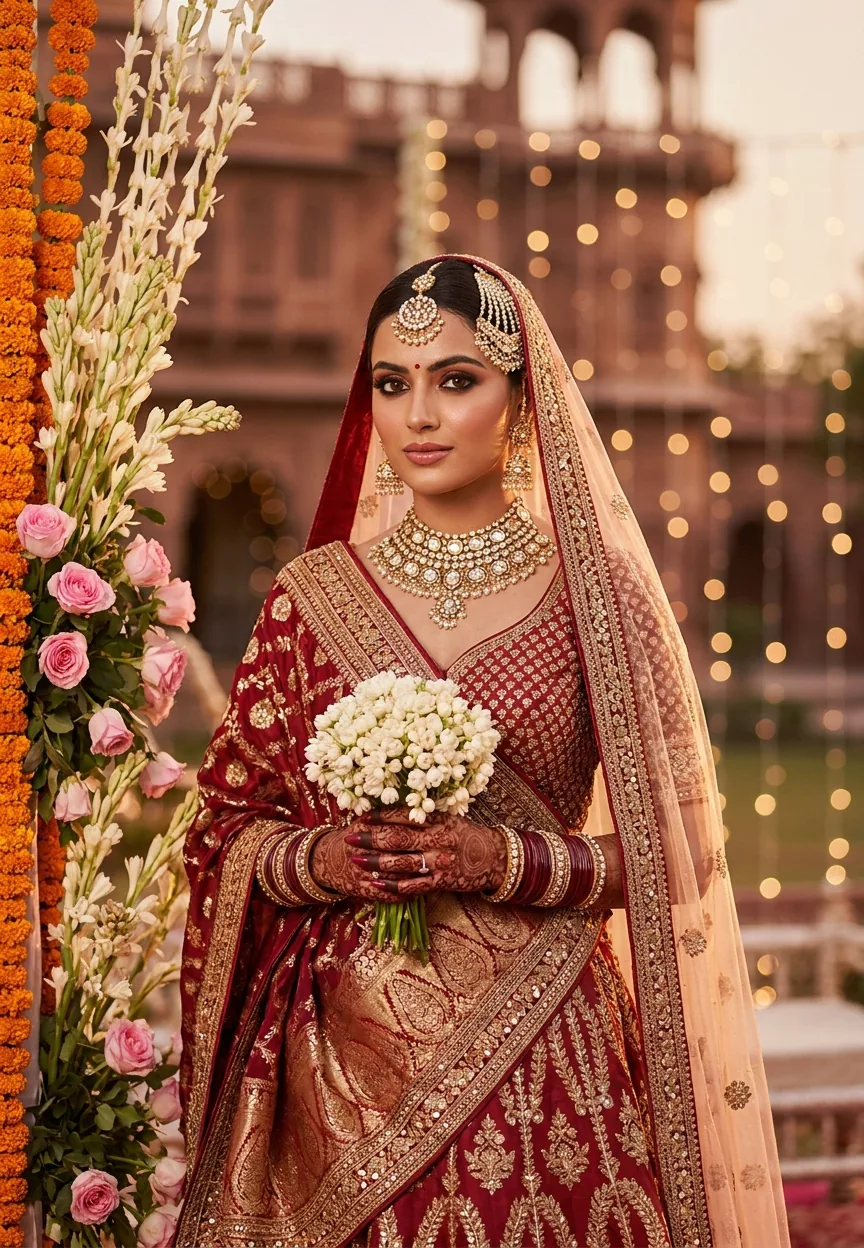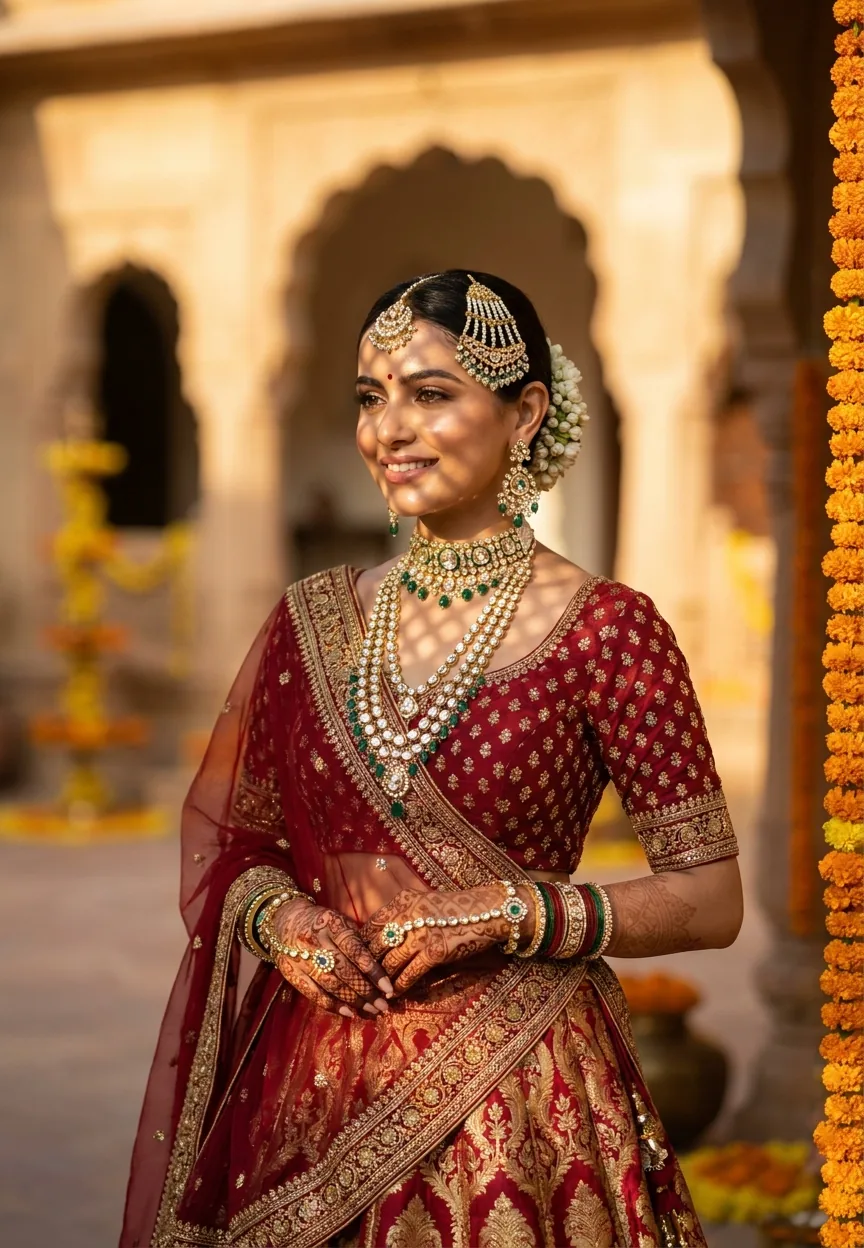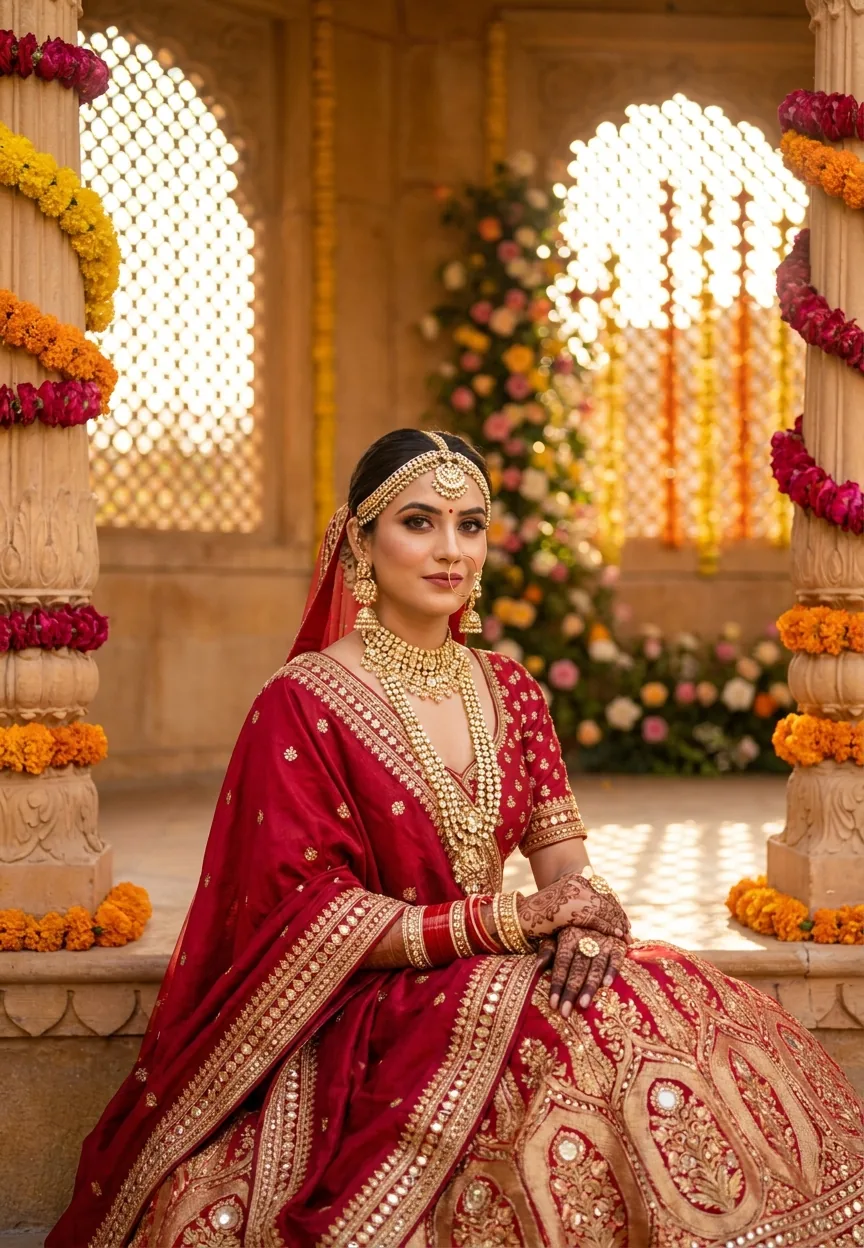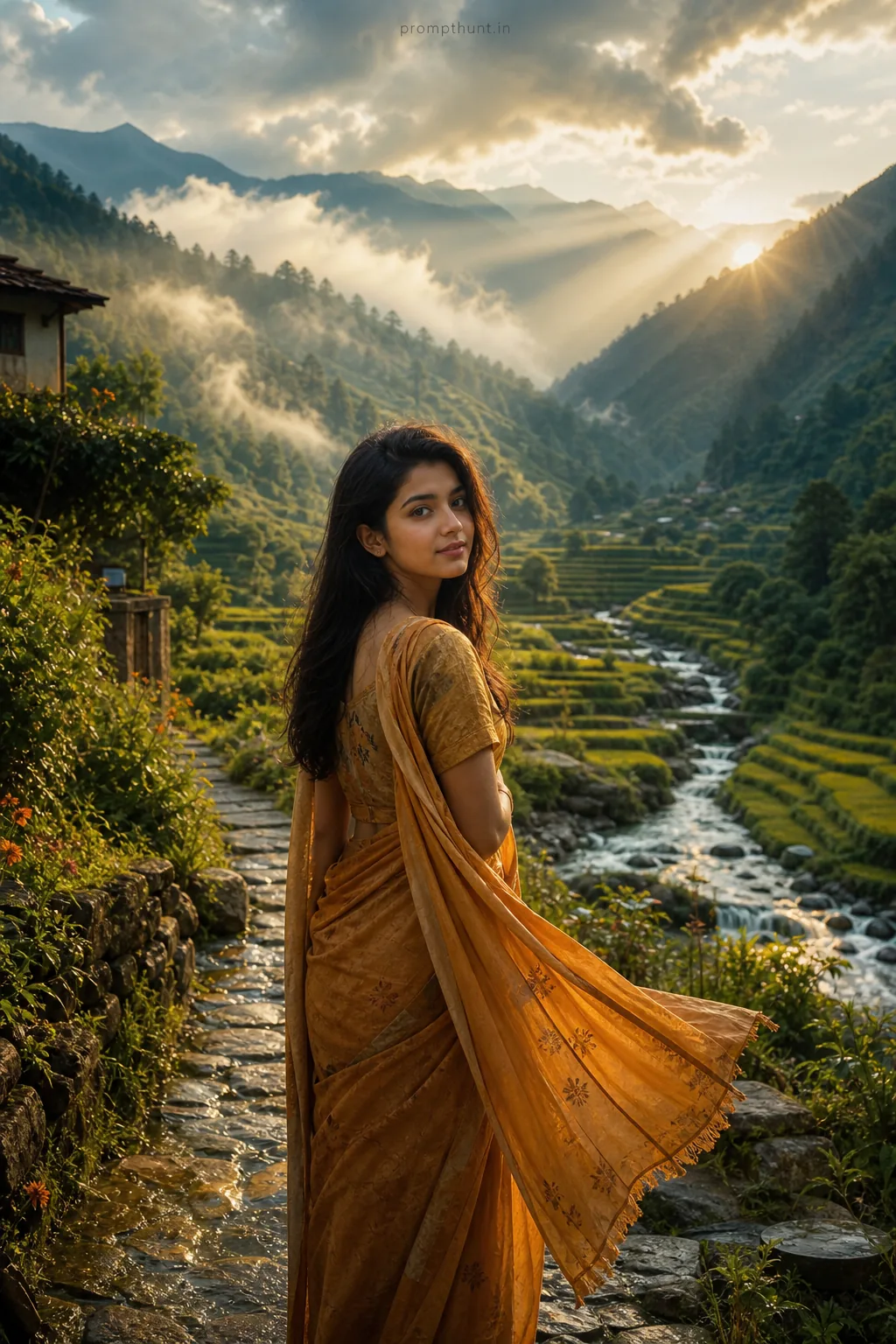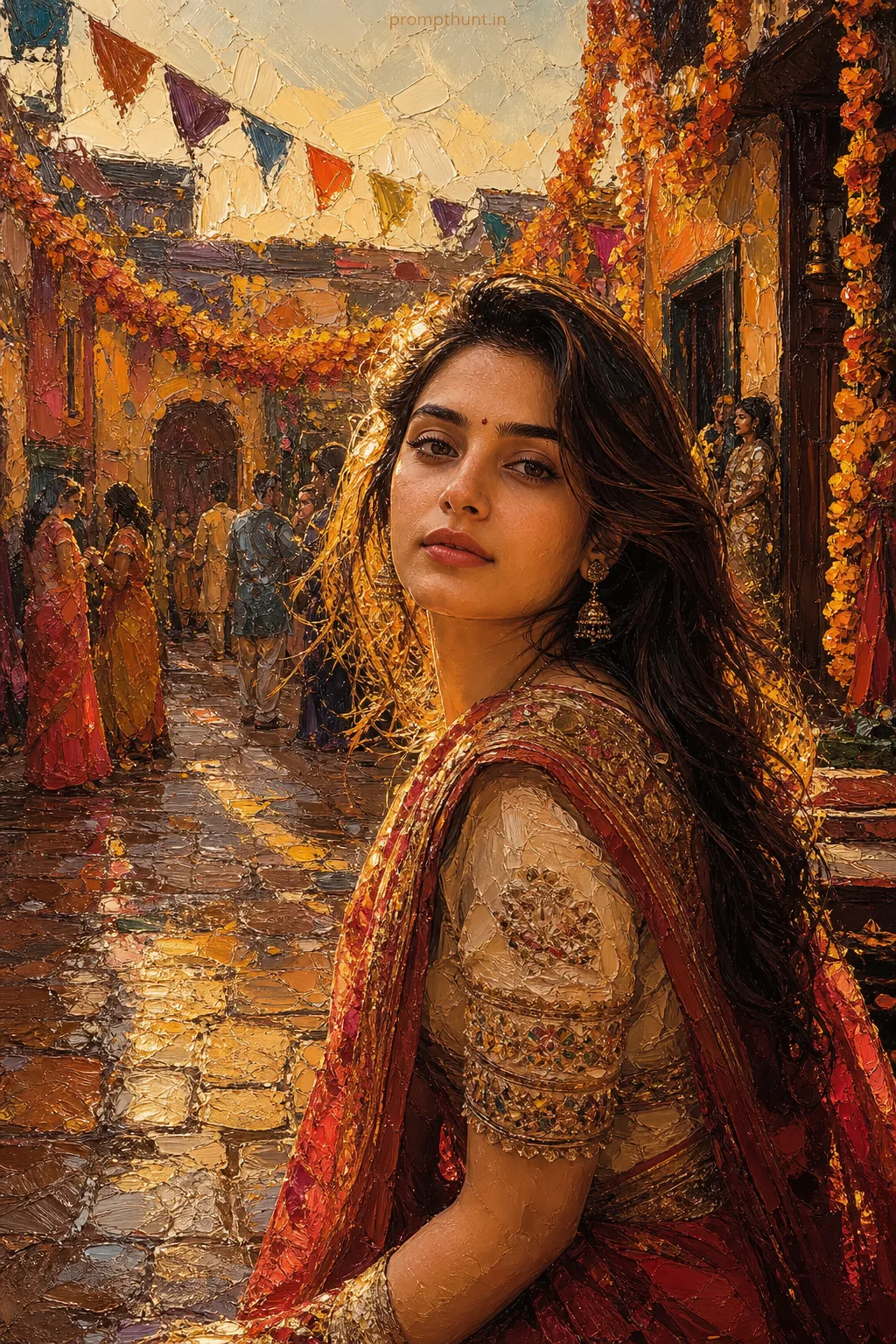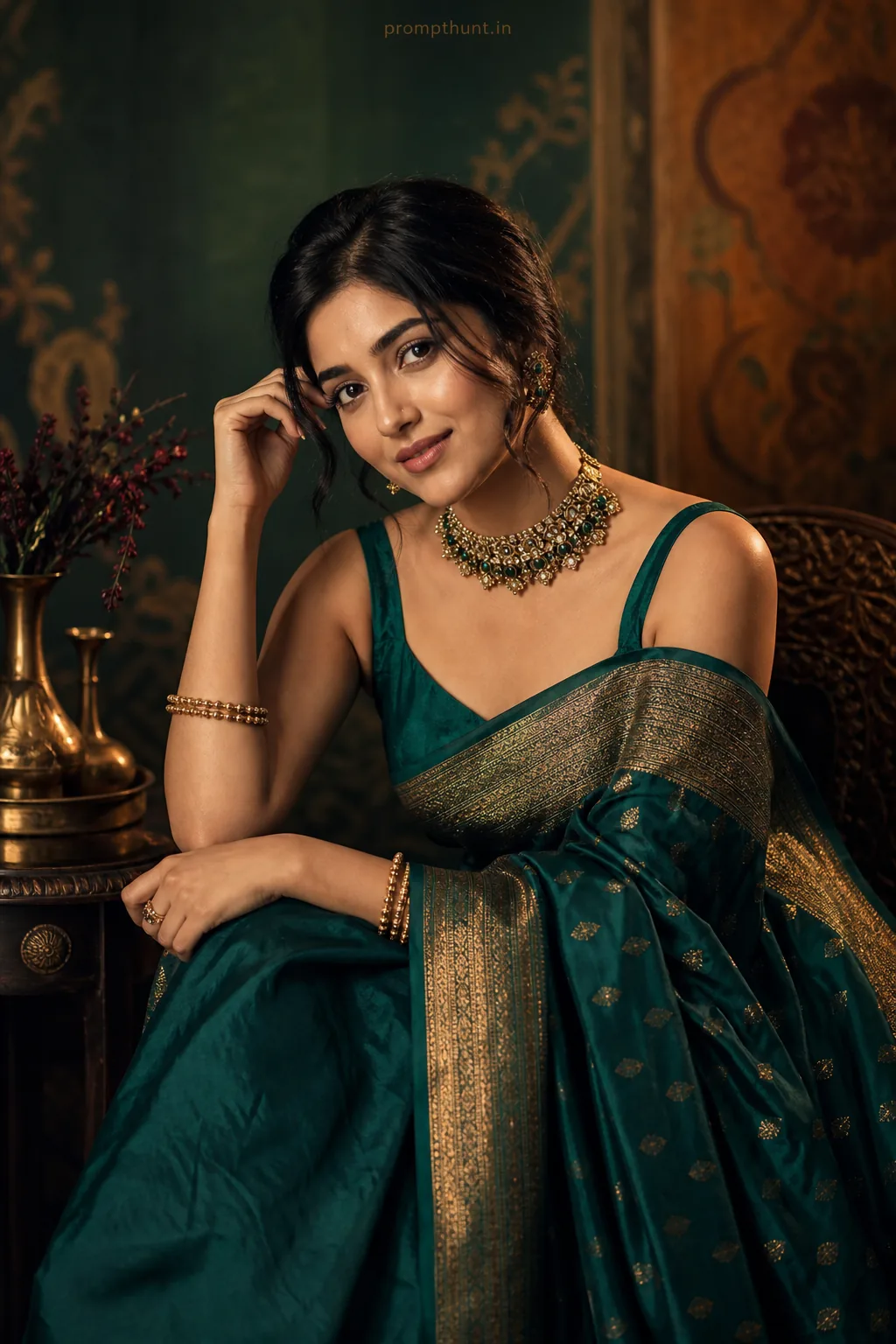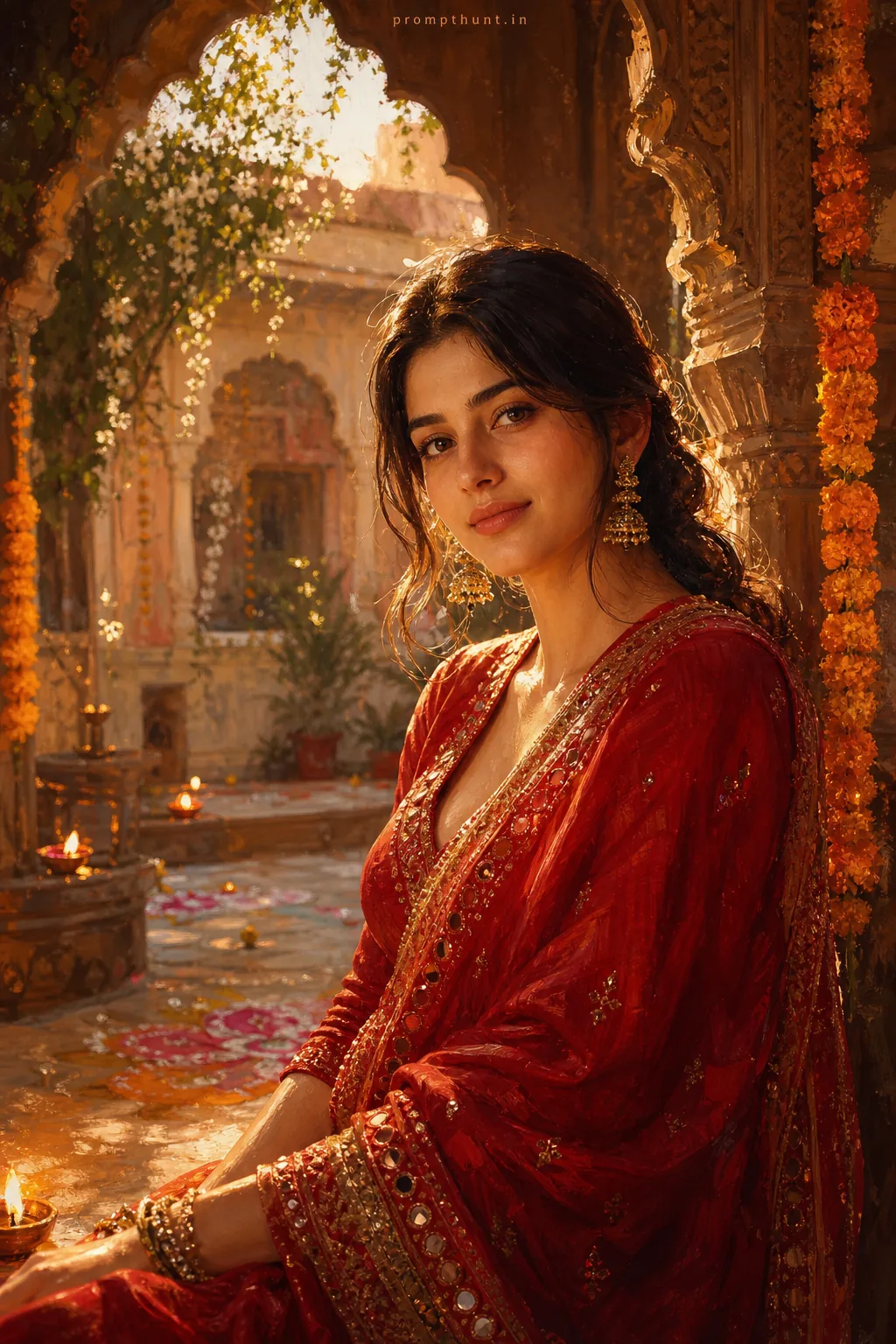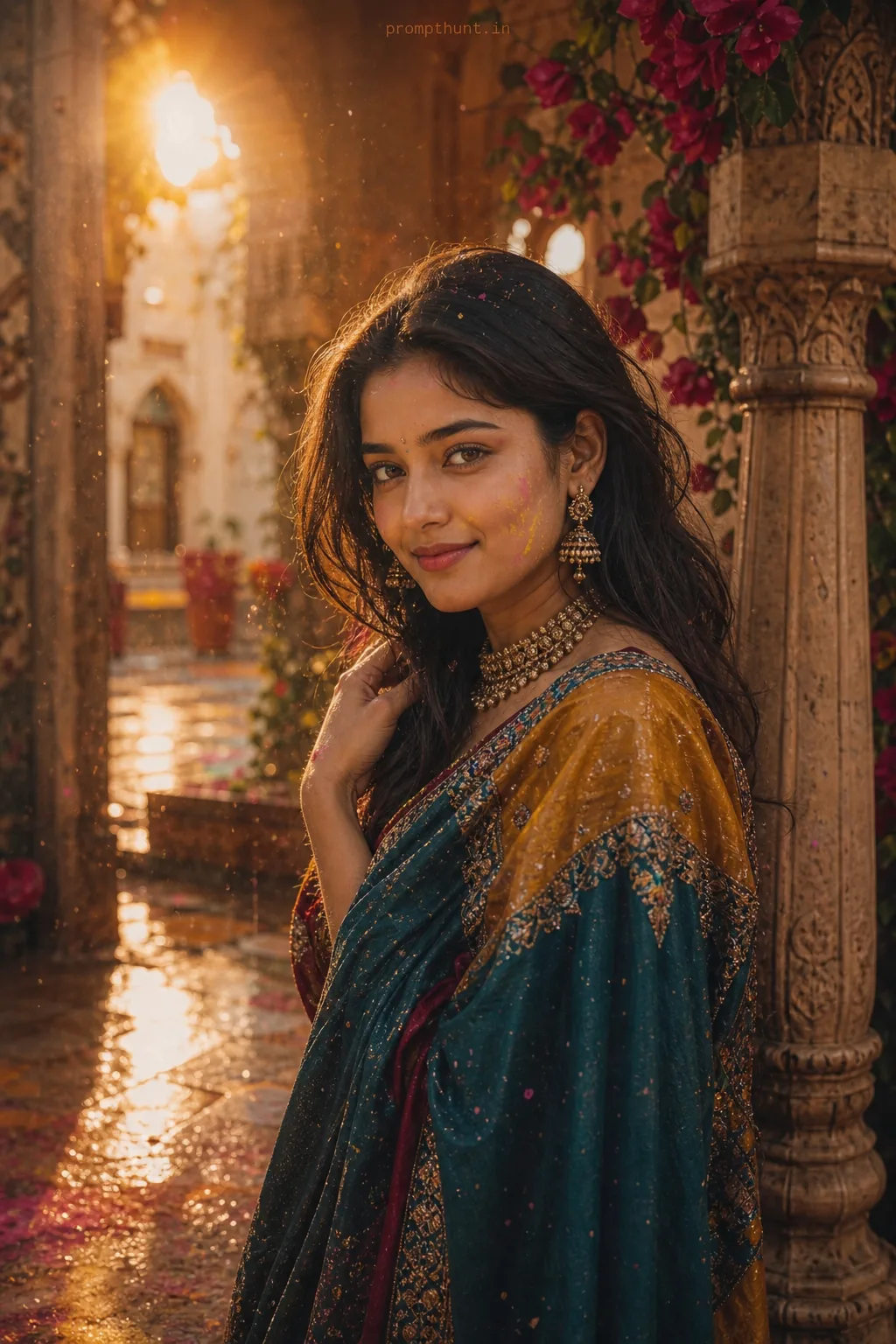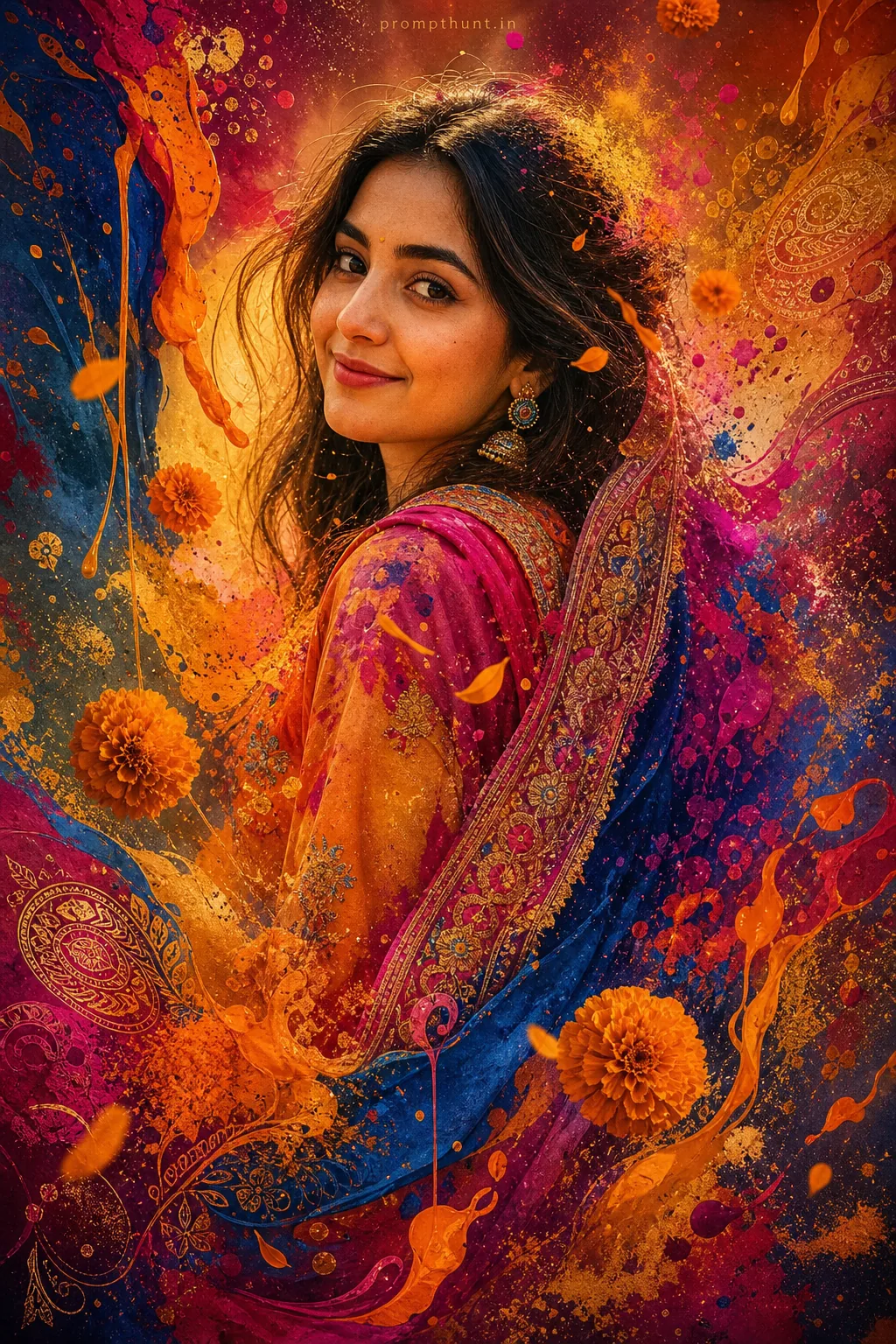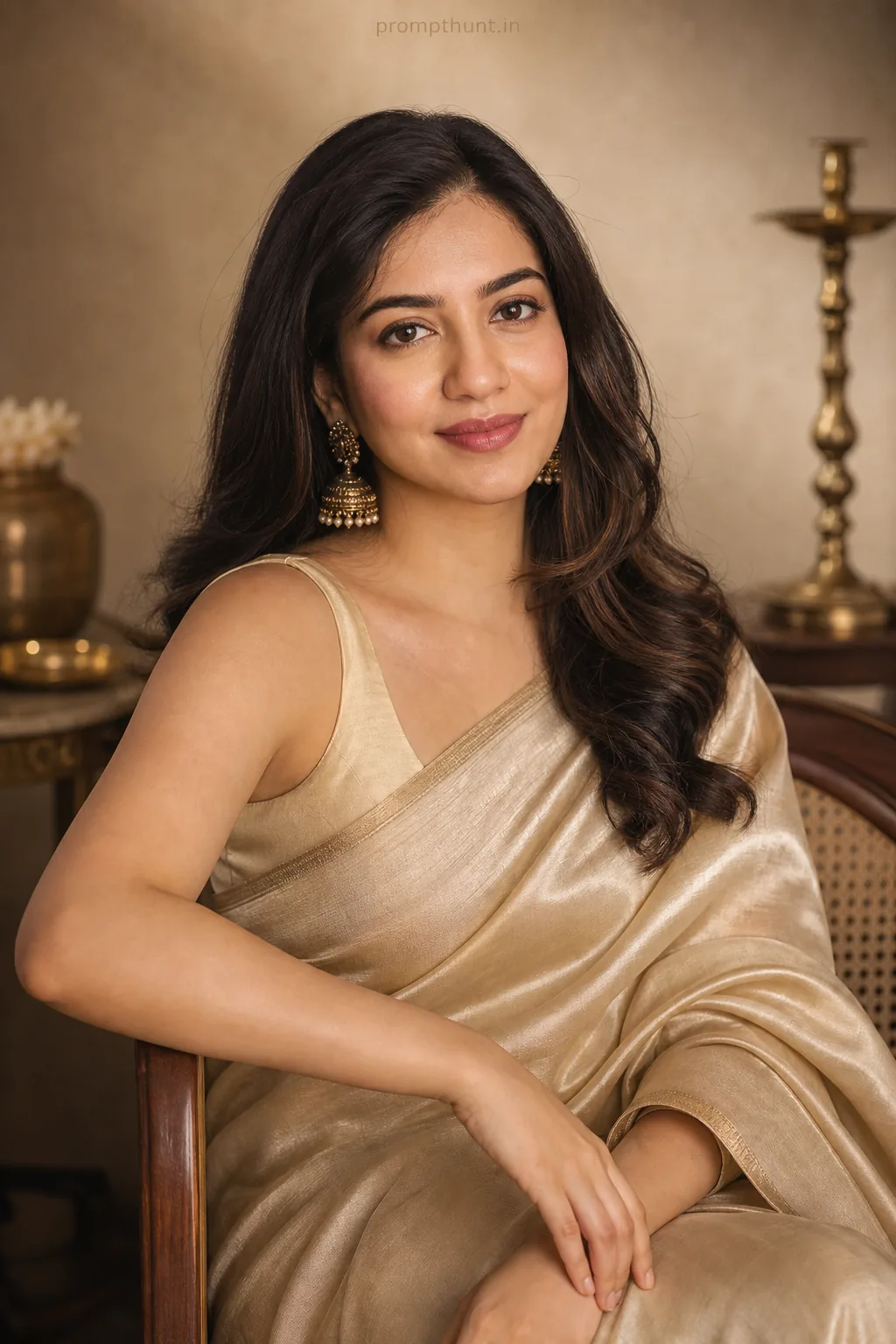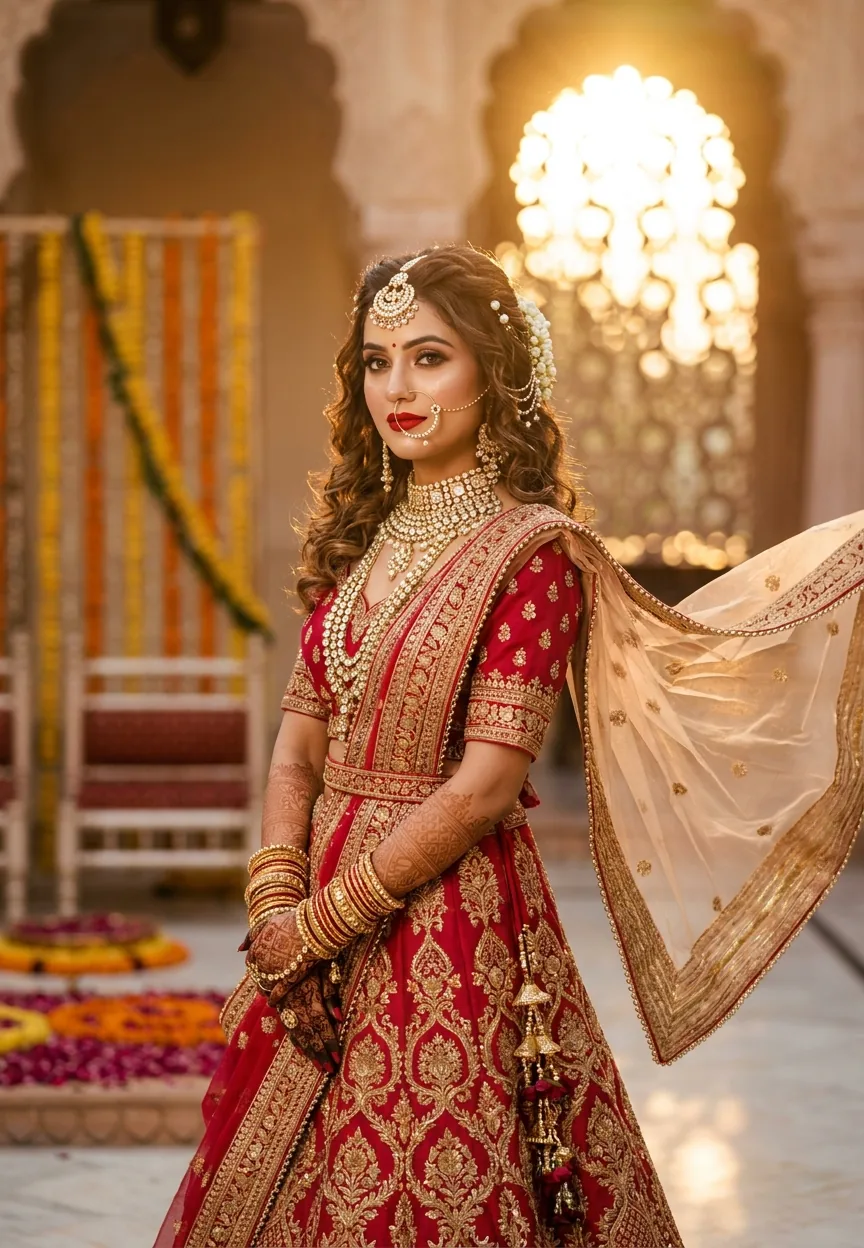
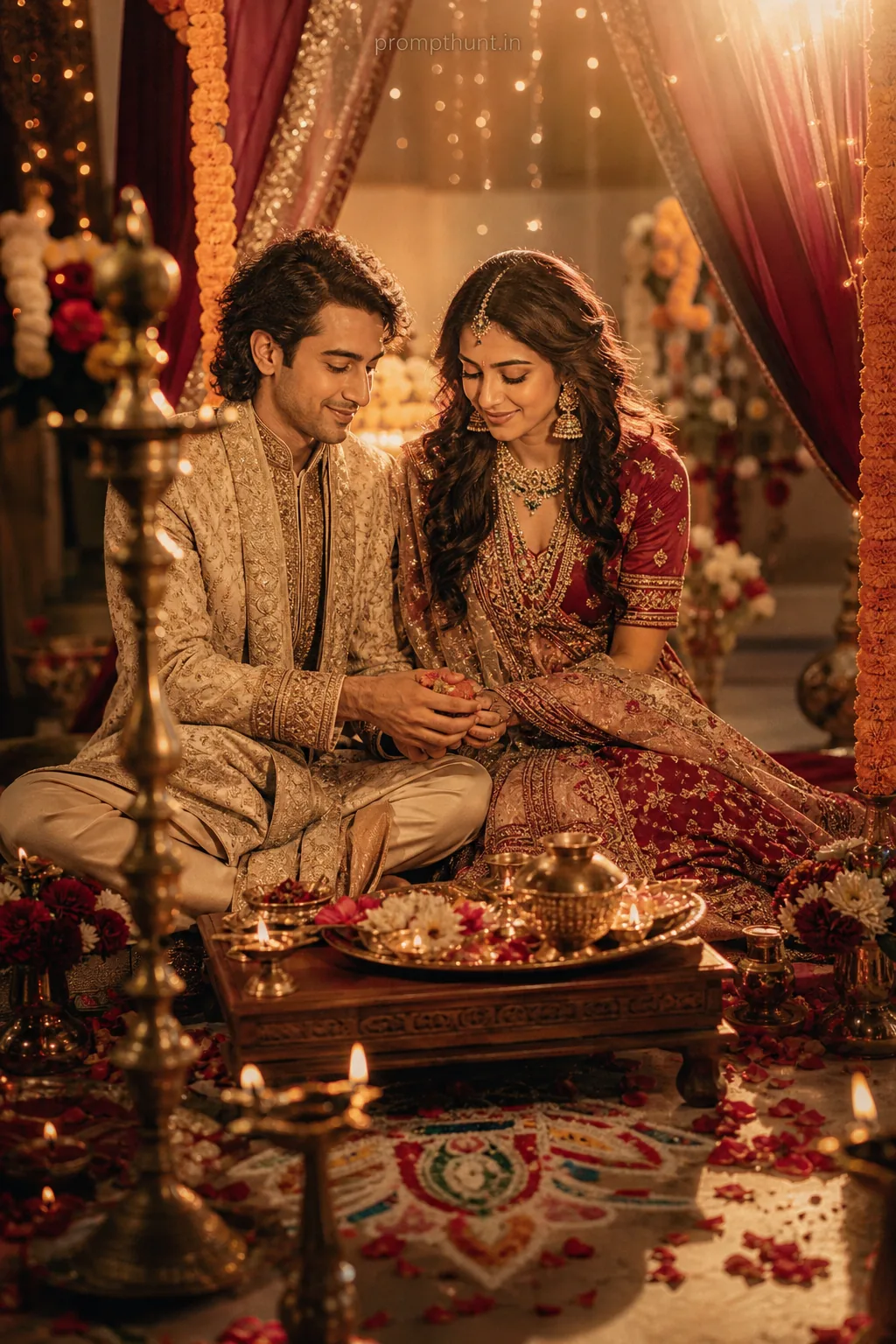
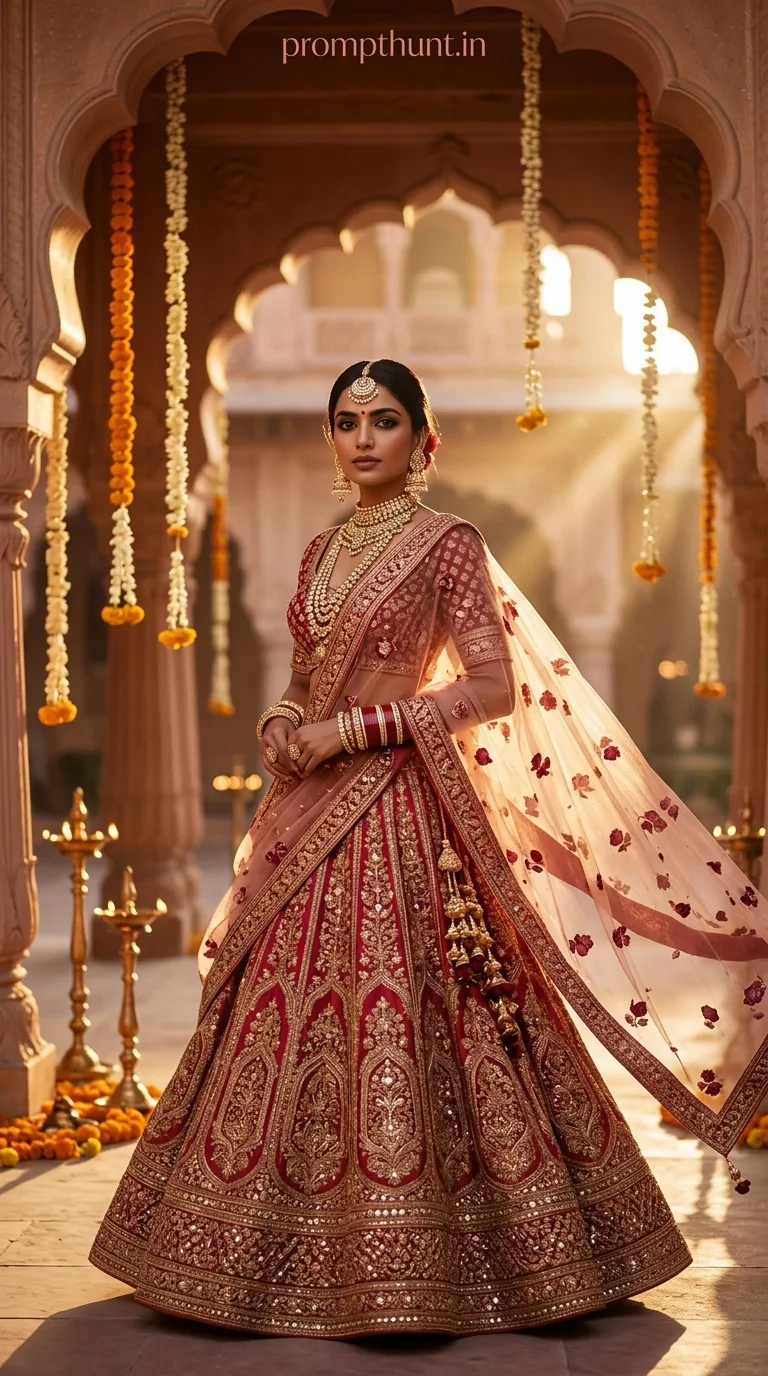
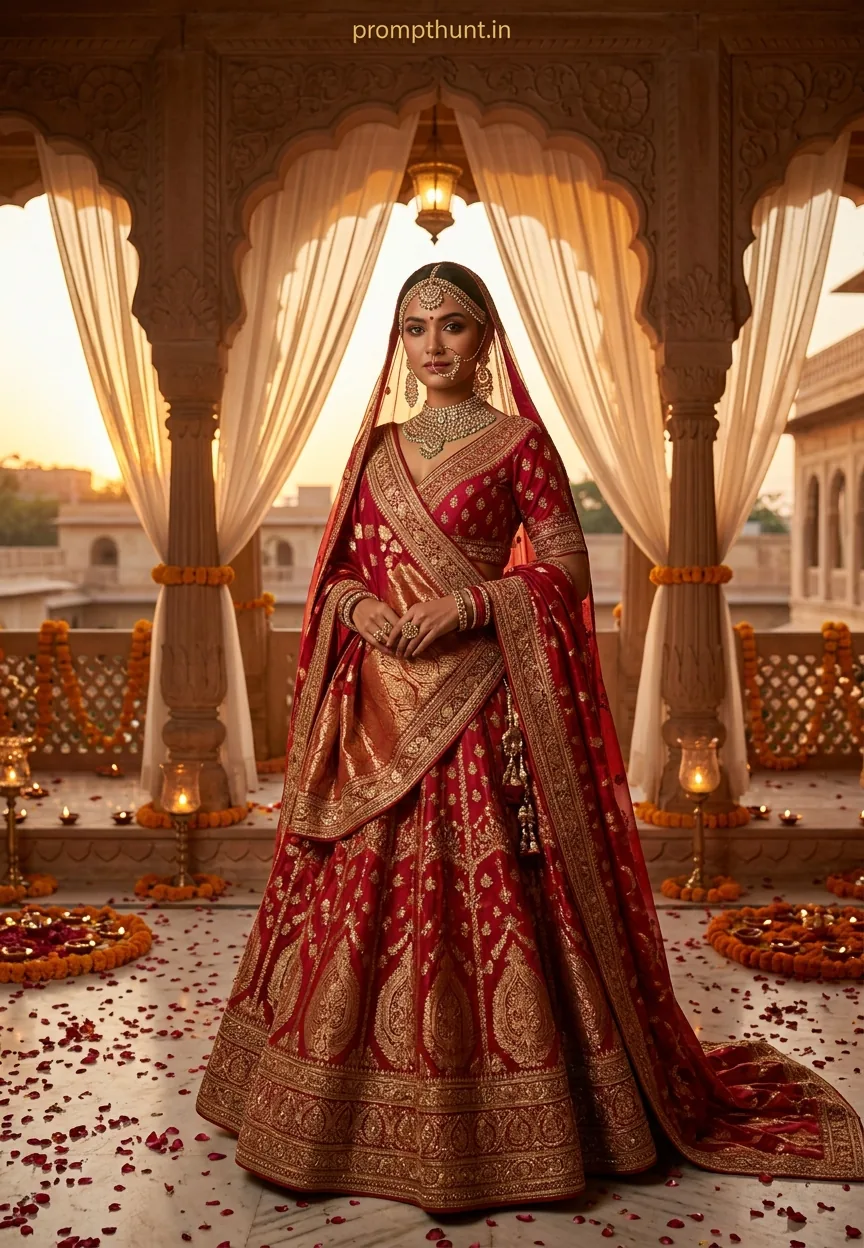
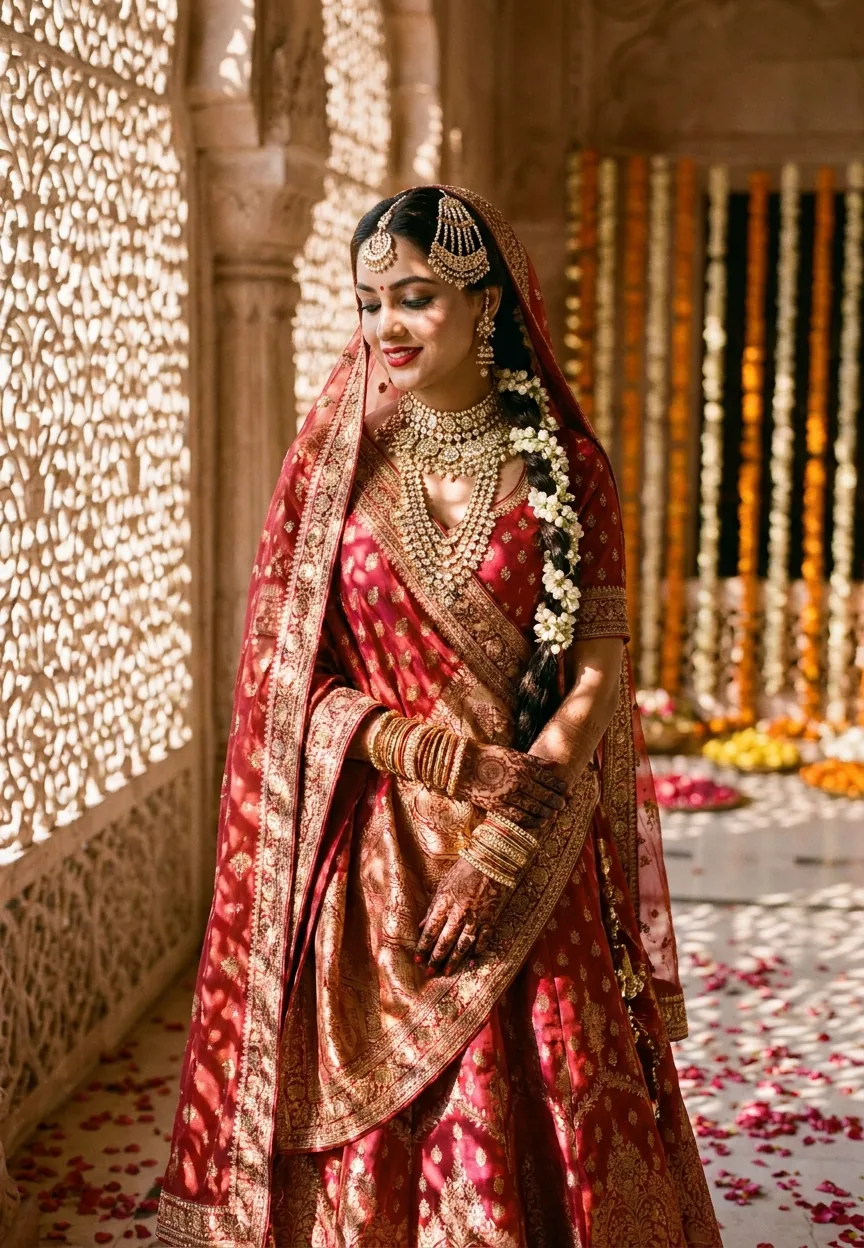
The Royal Indian Bridal Glow prompt generates magazine-quality AI wedding portraits featuring a bride in crimson Banarasi silk, kundan jewellery, and jasmine-pinned curls, bathed in golden hour light inside a marble haveli. It combines editorial fashion photography cues with rich saffron and champagne gold colour grading to produce cinematic bridal portraits that look like they belong on the cover of Vogue India.
Indian weddings don't do subtle. They do seven-course feasts, three-day celebrations, and lehengas so heavy they qualify as structural engineering. So it makes sense that the AI photo prompt doing the rounds right now doesn't hold back either. The Royal Indian Bridal Glow prompt has become one of the most-shared wedding-style AI edits on the internet, and photographers, content creators, and brides-to-be are using it to generate portraits that genuinely stop your scroll. Here's exactly what it is, how to use it, and whether it's worth your time.
Drop this prompt into any image-generating AI tool to create a photorealistic, magazine-cover Indian bridal portrait with golden hour warmth, rich jewellery detail, and cinematic colour grading — no studio, no stylist, no three-hour mehendi session required.
What the Royal Indian Bridal Glow Style Actually Is
This is an editorial bridal portrait style built around the visual language of high-end Indian wedding photography. Think Vogue India meets a five-star destination wedding in Rajasthan.
The key ingredients are specific. Crimson and gold Banarasi silk. Heavy kundan and polki jewellery. A marble haveli courtyard. Golden hour light filtering through carved jali screens. Marigold and rose petals softly blurred in the background.
Put all of that together and you get something that looks less like a candid wedding snap and more like a shot a celebrity photographer spent three days setting up. Except you generated it in about forty seconds. (Don't tell the photographer.)
The style sits firmly in the cinematic editorial bracket. It's not documentary. It's not candid. It's the bridal portrait you'd see on a wedding magazine cover — posed, lit beautifully, and colour-graded within an inch of its life in deep saffron and champagne gold tones.
The Prompt Itself
Copy this exactly. Every word is doing work.
A stunning Indian bride in her mid-20s standing in a grand haveli courtyard at golden hour, wearing a rich crimson and gold Banarasi silk lehenga with intricate zardozi embroidery, heavy kundan and polki bridal jewelry including maang tikka, nath, and layered haar, hands adorned with elaborate mehendi and gold chura bangles, soft loose curls pinned with jasmine flowers and pearl pins, face glowing with dewy bridal makeup featuring bold red lips and smoky kohl eyes, warm volumetric light casting golden bokeh through carved marble jallies in the background, marigold and rose petal mandap visible softly blurred behind her, a sheer dupatta draped gracefully over one shoulder catching the breeze, photorealistic ultra-detailed editorial fashion photography style, shot on Hasselblad medium format camera, 85mm portrait lens, shallow depth of field, rich warm color grading with deep saffron and champagne gold tones, vertical 9:13 aspect ratio, magazine cover quality, cinematic Indian bridal editorial aesthetic
How to Use It — Three Steps, No Surprises
Step one: choose your tool. This prompt performs best on Midjourney v6, Adobe Firefly, or DALL-E 3. Midjourney gives you the most control over the cinematic colour grading. Firefly handles the jewellery detail particularly well. Either works.
Step two: paste the prompt in full. Resist the urge to trim it. The prompt is long because every detail is load-bearing. Remove "Hasselblad medium format camera" and you lose the depth-of-field realism. Remove "zardozi embroidery" and the lehenga looks flat. It's like Jenga — pull the wrong piece and the whole thing wobbles.
Step three: run it at least four times. AI image generation is not a vending machine. You put in a pound, sometimes you get crisps, sometimes you get a philosophical question about whether crisps even exist. Run four variations, pick the best one, then use the variation or remix tools to refine from there.
If you're using Midjourney, add --ar 9:13 at the end of the prompt to enforce the vertical aspect ratio. That ratio is already baked into the prompt language but the parameter locks it in.
Tips for Getting the Best Results
A few things that actually move the needle.
Specify the light twice. The prompt already mentions golden hour and volumetric light. If your output looks flat, add "late afternoon directional sunlight, 4pm warmth" as a suffix. Nine times out of ten this fixes the washed-out look.
Push the jewellery detail. If the kundan and polki look generic, add "hyper-detailed traditional Indian goldwork, textured gemstone settings" after the jewellery list. AI tools sometimes interpret "heavy jewellery" as quantity rather than craftsmanship.
Watch the hands. AI and hands have a famously complicated relationship. (Picasso could relate.) If the mehendi-covered hands look wrong, generate the portrait without them in frame and crop to a tighter mid-shot. Problem solved, dignity preserved.
Colour grade after generation. Even a great AI output benefits from a two-minute pass in Lightroom. Drag the orange luminance up slightly, push the highlights warm, and pull a touch of green out of the shadows. That's the saffron-and-champagne tone nailed.
Aspect ratio matters more than you think. The 9:13 vertical ratio is deliberate. It's the proportion that magazine covers and Instagram portrait posts use. If you generate at square or landscape, the composition loses its editorial quality. Stick to vertical.
Why This Is Trending Across Indian Wedding Content
Indian wedding content is one of the fastest-growing niches on social media. Wedding photographers, bridal stylists, jewellery brands, and lehenga designers all need visual content constantly. AI bridal portrait prompts give them a faster, cheaper way to produce aspirational imagery between actual shoots.
The haveli aesthetic is specifically resonant right now. Rajasthani palace wedding venues have been booked out for three years running. There's a genuine cultural appetite for imagery that celebrates traditional craft — the Banarasi silk, the zardozi embroidery, the kundan work — against heritage architecture. This prompt delivers exactly that.
There's also a practical angle. Not every bride can afford a pre-wedding editorial shoot. This prompt lets stylists, photographers, and brides-to-be visualise a look — jewellery combinations, dupatta draping style, makeup palette — before committing to it on the actual day. It's a mood board that looks like a magazine cover. That's a genuinely useful thing.
Honest Opinion — When to Use This and When to Walk Away
This prompt is genuinely impressive. The output, when it works, is the kind of image that makes people stop and ask which photographer took it. That's rare for AI-generated content, and it's worth acknowledging.
But let's be straight about where it falls short.
The faces are still the weak point. AI-generated portraits of South Asian women have historically skewed toward a narrow and often inaccurate beauty standard. Skin tone accuracy, facial feature diversity, and the specific regional variation in Indian bridal aesthetics — a Bengali bride looks different from a Rajasthani bride looks different from a Tamil bride — are not things this prompt handles consistently. You'll get a beautiful result. You won't necessarily get an accurate or representative one.
Rule of thumb: use this for mood boarding, concept visualisation, and social content that's clearly presented as AI-generated. Don't pass it off as real photography. Don't use it to represent a specific real person's appearance. And if you're a wedding photographer using AI imagery in your portfolio without disclosure, that's a conversation you'll want to get ahead of.
The prompt is also heavily weighted toward a specific aesthetic — North Indian, high-budget, haveli-and-marigolds. That's a real and beautiful tradition. It's also not the whole picture of Indian bridal photography. If you want South Indian bridal looks, or Bengali saree aesthetics, or a more contemporary fusion style, this prompt needs significant modification. It's a starting point, not a universal template.
What it does brilliantly: colour, light, jewellery texture, fabric detail, and the overall cinematic warmth. For generating aspirational content, visualising a stylistic direction, or producing editorial-quality imagery for brands, this is one of the strongest wedding-style prompts out there right now. Use it for what it's good at and you won't be disappointed.
The Bottom Line
The Royal Indian Bridal Glow prompt is one of those rare AI tools that delivers on most of what it promises. Rich colour, cinematic light, extraordinary jewellery detail, and an editorial quality that genuinely earns the "magazine cover" description in the brief. Run it on Midjourney or Firefly, keep all the detail in the prompt, give it four attempts, and do a quick pass in Lightroom after. You'll have something worth sharing.
Just remember